Nautilus
The Genetic Secrets of Sperm Warfare

If you’ve ever taken a biology class, you might remember the principles of Mendelian inheritance (or at least having to illustrate them with Punnett squares). Basically, during sex cell formation, chromosomes segregate, and genes are independently assorted, giving every gamete an equal chance to have a copy of the genes.
For heterozygous individuals—that is, those carrying both a dominant and recessive allele—that means half the gametes will get a dominant copy and half will get a recessive one. Unfortunately, though, not all genes play by the rules.
In fruit flies, for example, there’s a gene called Segregation Distorter (SD) that can rig the system. Fruit flies carrying both a copy of SD and its non-distorting form will produce only SD gametes. How selfish genetic elements like this manage to break the rules has been something of a mystery, but new research published in Nature Communications is revealing one such mechanism.
Read more: “What You Don’t Know About Sperm”
Studying different species of fruit flies with selfish segregation distorting genes, geneticists at the University of Utah discovered that selfish chromosomes can exploit a genetic quality control checkpoint mediated by the Overdrive gene (Ovd). Under normal circumstances, Ovd eliminates damaged or otherwise abnormal sperm cells. But selfish chromosomes are able to hijack the process, using Ovd to eliminate rival sperm cells, which tilts the odds in their favor.
“Overdrive’s normal function is acting as a blocker of bad gametes. When you remove the blocker, then the selfish behavior goes away,” study author Nitin Phadnis explained in a statement. “That doesn’t mean Overdrive is the selfish gene—it’s just being hijacked.”
We’re more accustomed to thinking of “survival of the fittest” as a competition between individuals, but these findings are a good reminder that it can happen between our own genes as well.
Lead image: Butusova Elena / Shutterstock
Why Cats Always Land on Their Feet
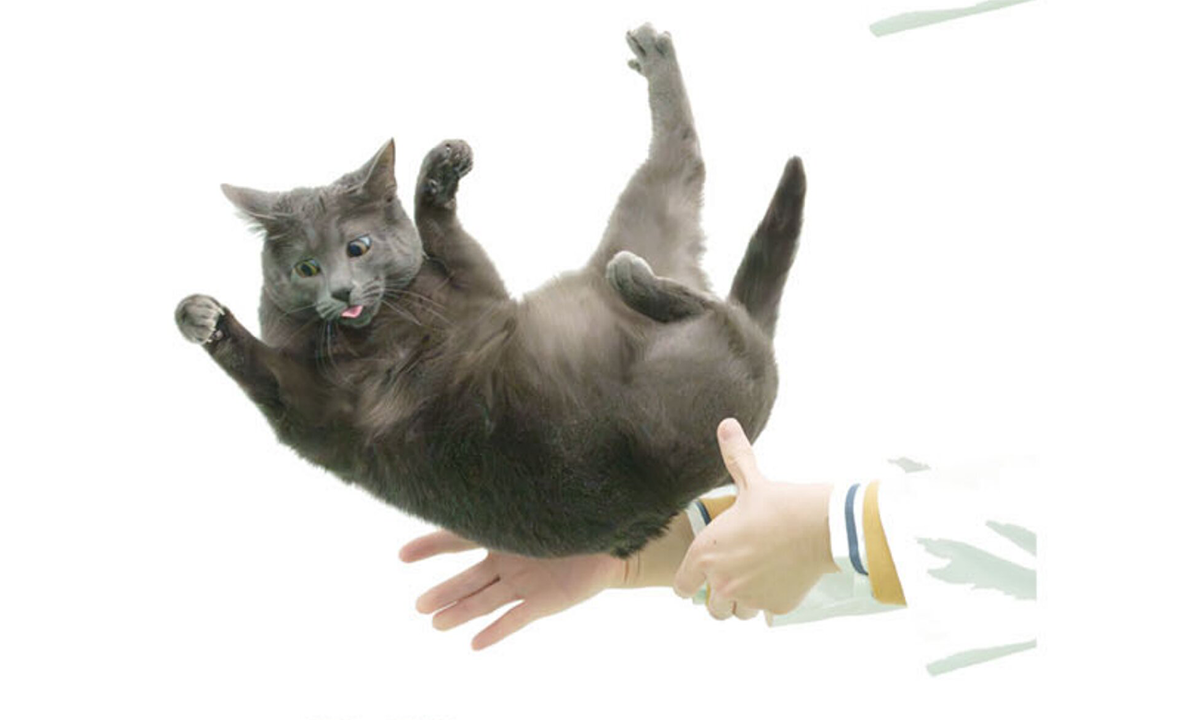
Falling cats always land on their feet” is up there with evolution by natural selection and law of gravity in terms of ironclad scientific truisms understood by the public, but it wasn’t always that way. The 19th-century French physiologist and early film pioneer Étienne-Jules Marey was the first to film felines dropped upside down and record how they twisted their bodies midair to land safely.
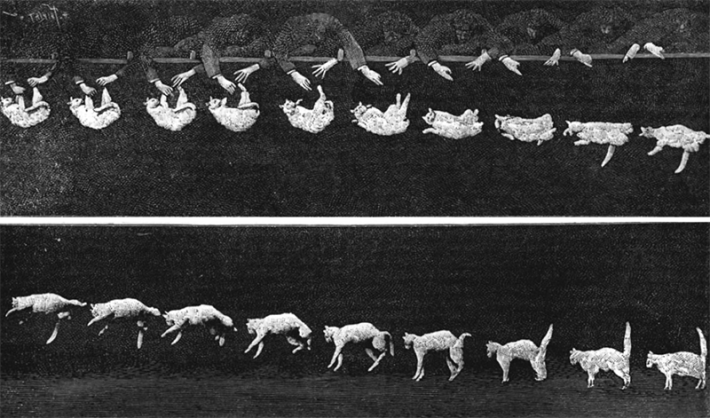
Marey’s short film kicked off a scientific debate that’s continued among physicists and physiologists for over a century. The question boils down to this: If cats have nothing to push off of, how can they manage to turn midair?
A new study published in The Anatomical Record zeroes in on feline anatomy to provide an answer.
To find out how cats manage this acrobatic stunt, veterinary physiologists from Yamaguchi University in Japan focused on their backbones. They performed a series of “destructive failure” tests on segments of the spines from five donated cat cadavers. (In other words, they twisted them until they broke.) They found that regions of the cat’s spine display different degrees of flexibility—the thoracic spine in the upper body was incredibly flexible, while the lower lumbar spine was relatively rigid.
Read more: “Can a Cat Have an Existential Crisis?”
In the less macabre portion of the experiment, they took a page from Marey’s book (or better put, filmography) and used high-speed cameras to film living cats reorienting themselves as they fell. First, the cats twisted their heads and forelimbs toward the ground, then their lower bodies followed, allowing all four legs to line up and cushion their fall.
“These results suggest that trunk rotation during air-righting in cats occurs sequentially, with the anterior trunk rotating first, followed by the posterior trunk, and that their flexible thoracic spine and rigid lumbar spine in axial torsion are suited for this behavior,” the study authors wrote.
Simply put, the stiffer lumbar spine acts as a stabilizer of sorts, anchoring the more fluid thoracic spine and allowing the cat’s upper body to twist midair. With the front half taken care of, the hind portion can follow suit.
It’s a satisfying answer to an age-old question, but is it satisfying enough to convince scientists to stop dropping cats? Probably not.
Lead photo by Higurashi, Y., et al. The Anatomical Record (2026).
What Doomsday Prophecies Say About Us
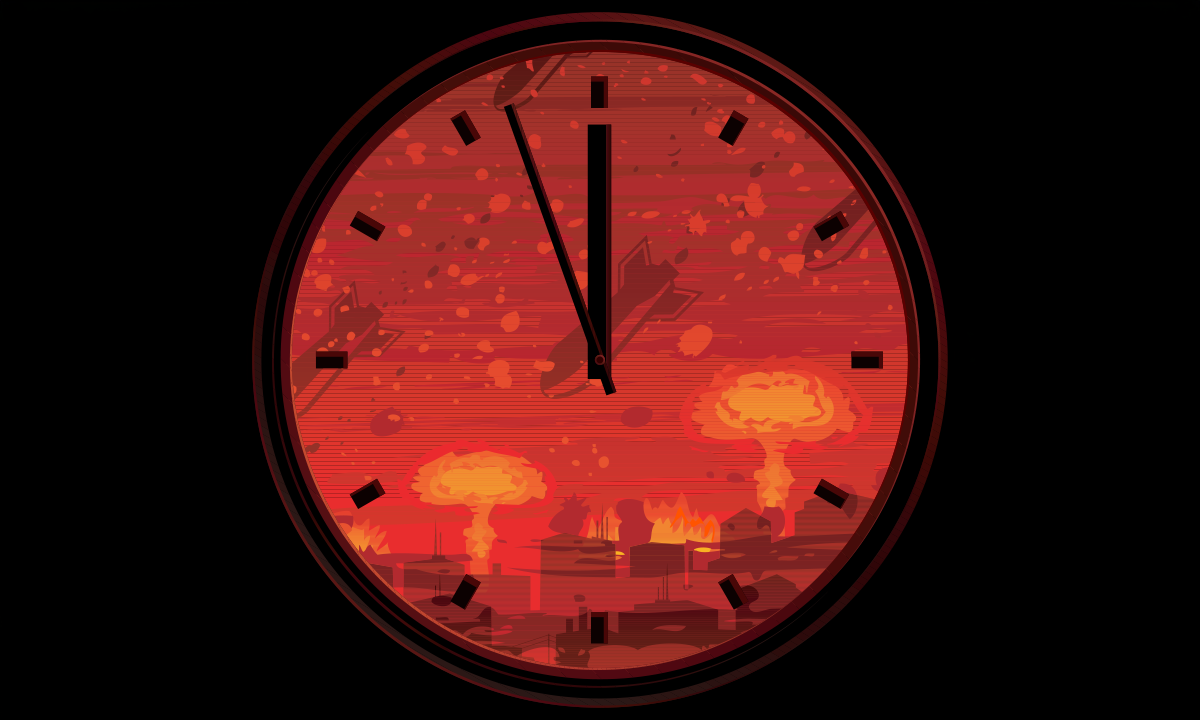
The Doomsday Clock now reads 85 seconds to midnight. The end of the world is closer than ever, it seems—if the metaphorical timer is to be believed. Managed by the Bulletin of Atomic Scientists with input from experts and Nobel Laureates, the clock was created in 1947 in response to the nuclear menace of the Cold War. But it now takes into account not only threats from nuclear arsenals, but rogue artificial intelligence and global biological calamities such as climate change and pandemics. The clock is reset every year, and has moved progressively closer to midnight since 2017.
It’s perhaps no huge surprise then that almost a third of people in the United States now expect the world to end during their lifetimes. This was one finding of a recent study published in the Journal of Personality and Social Psychology. The team of researchers drew on surveys of 3,400 people in Canada and the U.S. They also found that how people think about the causes of impending apocalypse shape their willingness to act to forestall it. Those who thought human hubris was to blame were willing to take extreme measures. Those who thought supernatural forces were at the root of it were not.
Apocalyptic thinking has a long history, so I reached out to Matthew Gabriele, professor of medieval studies in the Department of Religion and Culture at Virginia Tech, to find out what he makes of the new findings. Gabriele, who wasn’t involved in the new study, has published widely for both academic and popular audiences on religion, violence, nostalgia, and apocalypse—in the medieval world and the modern one. His Oxford University Press book Between Prophecy and Apocalypse came out in early 2024.
I talked with Gabriele about how views of the apocalypse have changed over time, what has historically determined whether doomsday prophecies drive constructive reform or violence, what Effective Altruism has in common with apocalyptic thinking, and what lessons if any we might draw from medieval cathedrals.
A recent study found that almost a third of people in the U.S. and Canada believe the world will end during their lifetimes. That seems like a striking figure, but is it surprising? Has a belief that the end is near been relatively consistent in Western culture across time?
People have always thought the end was coming. Can we put historically confident numbers on how many? That’s a little bit more problematic. But there’s certainly textual evidence, artistic evidence, and other cultural artifacts that show that end-of-the-world thinking has been around for a long time, and that’s true across different monotheistic religious traditions, such as Christianity and Islam.
The authors suggest that today, the belief in impending apocalypse is an unexpected point of agreement at a time of great polarization in the U.S., across a wide variety of disparate groups—from preachers to atomic scientists to UFO cults to artificial intelligence engineers. Has belief in the apocalypse been a unifying force historically?
My work is primarily focused on the European Middle Ages, so pre-modernity, and I’d say that during periods in which we see clear textual or artistic evidence of a concern about the end of the world, that did tend to cut across social class. There was an older strand of scholarship that said this was just a lower-class thing. The peasants were worried about these religious doomsday ideas, but the elites, they knew better. And that’s just absolutely not true.
How has the definition of apocalypse changed over time?
The problem of definition has troubled scholars of apocalypse for a long time as well. The term apocalypse comes from the Greek apokálypsis, which translates as revelation, an unveiling of a truth. So it’s not necessarily about disaster, or catastrophe, but certainly in the 20th and 21st century, it’s taken on that meaning.
But what Americans and Canadians in the 21st century consider the end of the world is probably not the same as what anybody in the past would’ve considered the end of the world, before the threat of nuclear annihilation, climate calamity, and global pandemics became a possibility.
Since the beginning of the 20th century, the function of mass media has been that we’re all consuming basically similar news information, in different ways. Everybody is aware right now of the war in Iran. Everybody’s aware of the potential for a nuclear bomb. Everybody’s aware of the sci-fi fantasy threats of zombies or aliens that inhabit American popular culture and the world. But everybody’s probably thinking about the apocalypse in quite different ways. If you asked an atomic scientist what the end of the world looks like, they’re going to say something different than an evangelical pastor.
It seems as though apocalyptic thinking attributed to supernatural forces has led to really diverse outcomes historically—from reform movements to violence to colonial projects to state conservatism. What determines whether society will head in one direction versus another?
That’s a great question and I don't have a great answer. My initial thought would be that Protestant Christian traditions, especially ones driven by Calvinists, who believe in predestination, would have a very limited understanding of how they can impact the course of sacred time. So in their case, apocalyptic thinking might lead to inaction: There’s nothing you can do. But in Catholic or Orthodox traditions, there’s an opposite understanding of things: Humans have more agency. They might not be able to change God’s plan for the world, but they could influence it subtly in some ways, making conditions right on this Earth so that the end of the world might be held off for a time. They might think that supporting a divinely anointed king, or leading a reform movement that would create a more moral and just world, could delay the end. So my feeling is that it would really depend on the particular community.
Read more: “Dr. Doom on the Hottest Summer (So Far)”
When did the idea that humans could create apocalypse themselves first arise? Was it with the origins of nuclear warfare, or did it happen earlier than that?
Yeah, in the 1940s and 1950s, the world became preoccupied not just with Hiroshima or Nagasaki, but the arms race of the early Cold War—the possibility that we could have a nuclear war triggered between the U.S. and Soviet Union that could annihilate not just those countries, but life on Earth. Before that time, death on that scale was almost impossible. The exception was the flu epidemic that killed millions across the world in 1918. That led to end-of-the-world speculation. But the plague is an old idea that goes back to ancient Egypt. It’s talked about in the book of Revelation, and it’s talked about within other traditions as well.
Concern about the end of the world has always been with us. But the change from belief that something theological would drive it, to the possibility of human-made destruction, is absolutely new. That shift seems to have excited more speculation because there’s just more ways that it could happen. The Doomsday Clock, for instance, is super close to midnight right now. But that’s a purely secularist kind of participation in end-of-world thinking. Trying to time the end in this way had traditionally been a theological speculation.
Is there any danger in secular progressives or environmentalists adopting the language of apocalypse around climate change? And does history tell us anything about that kind of danger?
This is one thing that the study could potentially be useful for, because it’s kind of measuring generalities. What does the language of the end of the world want people to do? If there’s a way of thinking about the end of the world in a specific register that gets a certain group of people motivated to do something, then this could be very helpful for kind of political communication: to highlight the importance of climate change and highlight the importance of nuclear disarmament. But the findings are a little counterintuitive. The study found that people who think supernatural apocalypse is a good thing are somehow more motivated to act to solve social problems. This is something that I’d want to understand further.
Are there any groups today that are using apocalyptic language in constructive ways to solve global challenges?
I can’t think of anything positive. Christian nationalists have been using apocalyptic language for a long time. You see that now with the Iran war. There’s a sense that the conquest of Persia, as they call it, will lead to Armageddon coming about and the end of the world and the last judgment. But as far as secular progressive groups go, it seems to me that they’ve shied away from that language. Like there isn’t the urgency that we saw in the early part of the 21st century. I don’t know if that’s just a political change because Trump won the election in the United States, and politics shifted to the right also in Europe, but there seems to have been a retreat from apocalyptic language. I don’t know if that’s because they weren’t getting the reaction they needed.
You often hear about the medieval cathedral as evidence that people could build a future even when they were expecting the world to end. What do you think about this notion, and is there an equivalent today?
The vast majority of people in the past weren’t necessarily worried about when the end was coming. They knew it was coming, and it was possible it would come soon, but most of them had the attitude that you gotta just get on with your life. If you’re a peasant, for example, which was the vast majority of Europe during the Middle Ages, you were more worried about whether your crops were going to succeed or fail. That’s the thing that you cared about. If you were a petty lord, you were worried about whether your serfs were going to bring in enough corn or grain for you to be able to live comfortably. The investment in things like a cathedral for the glory of God was just part of everyday life.
It reminds me a little bit of the Effective Altruism movement that became focused on protecting against existential threats to humanity, such as rogue AI, pandemics, or nuclear war. They weren’t predicting the end necessarily, just taking a long-term view of what needs to be done to protect the future of humanity.
It’s a similar form of thinking: You prioritize the things that are important to you. Maybe the world is going to end, maybe it’s going to not, but you just have to do what you can along the way.
Lead image: Taily / Shutterstock
Here’s How Snakes Defy Gravity to Stand Up

Snakes are depicted as slithering around on the ground. But the snake behavior that humans find even more alarming is when they raise body parts off the ground in strike poses or climbing stances. A recent study in Journal of the Royal Society Interface examines how snakes can stand nearly upright, wielding up to 70 percent of their body length into the air, a feat made all the more remarkable by their flexible bodies and absence of limbs.
A team of Harvard University engineers, along with a University of Cincinnati biologist, quantified experimental observations of two tree-climbing species: brown tree snakes (Boiga irregularis) and juvenile scrub pythons (Simalia amesthistina), and then modeled the forces behind their vertical movements.
“For some it may be the stuff of nightmares, but we’ve now analyzed, mathematically and physically, the hidden physics and control strategies that allow snakes to defy gravity,” said study author L. Mahadevan in a press release.
Read more: “Snakes Break All the Rules”
In each trial, a snake was placed on a lower perch and filmed as it extended its body to reach a higher perch. The distance between the two perches was incrementally increased from 11.8 to 31.5 inches—or until the snake could no longer reach the upper perch.
In lieu of directly measuring the muscles used in climbing, the researchers used data from a prior study coupled with their video observations to model the snake as an active elastic filament controlled by muscular forces. They discovered that targeted muscle contractions in a short “boundary layer” near the base of a snake’s tail allow it to effectively stand up. Rather than stiffening its whole body, a snake leverages itself up from the base, remaining so perfectly vertical as to escape any pulls of gravity.
And so, their biggest challenge turns out to be maintaining the perfect upright posture, which the study authors equate with “balancing an inverted pendulum.”
To that end, imagine stacking Jenga blocks; as long as each layer is directly over the other, the tower stays erect. It may sway a bit, which upright snakes also do, but it remains intact. As soon as one block is a bit off, however, the Jenga tower—or in this case, snake—crumples.
Lead image: Ken Griffiths / Shutterstock
Newly Discovered Species Changes the Origin Story of Magic Mushrooms
If you come across a mushroom on a hike, there’s a decent chance it’s from a species that’s entirely unknown to science. In fact, we don’t even know how many fungi species there are. Current estimates put the number anywhere between roughly 2 million and 13 million, but only around 150,000 have been described—a tiny sliver of existing species even if the most conservative estimates are correct.
Now, according to a study published in the Proceedings of the Royal Society B, we can add one more fungus species to the list—and its discovery is rewriting the origin story for magic mushrooms.
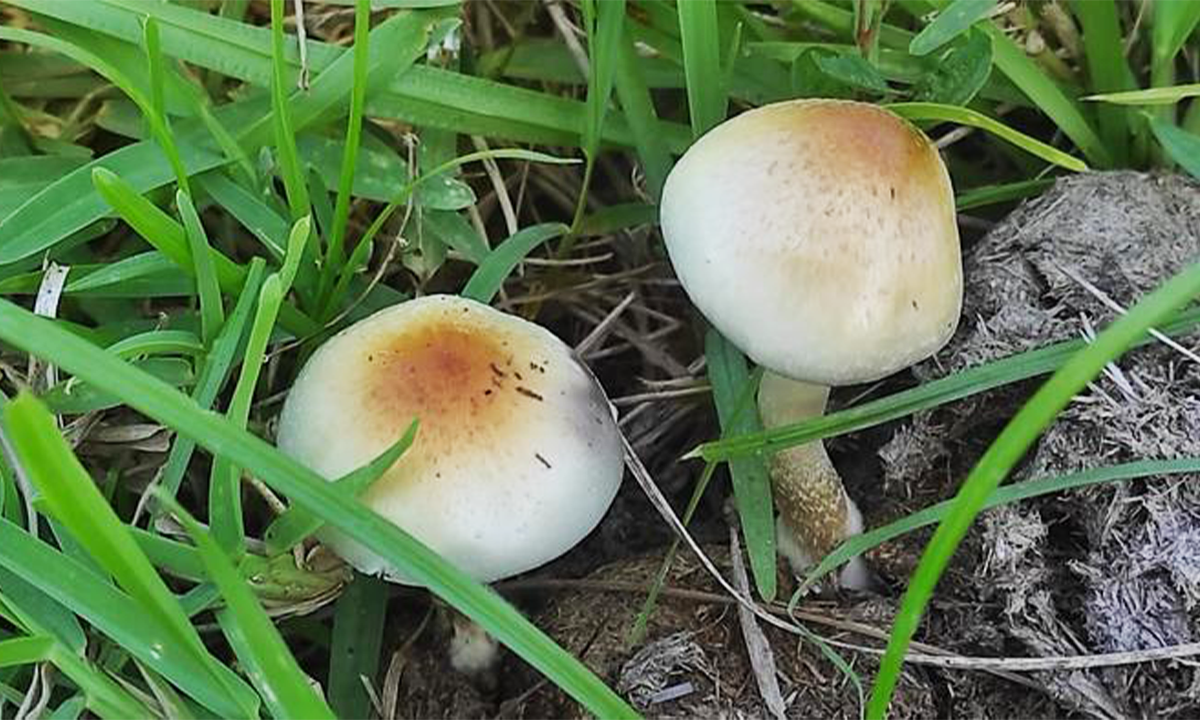
An international team of mycologists identified a new African species of fungus that was hiding in plain sight. Originally thought to belong to the traditional magic mushroom species, Psilocybe cubensis, the team’s analysis revealed the new species has distinct genetic, ecological, and chemical characteristics. They named it Psilocybe ochraceocentrata for the ochre-yellow coloring on the crown of its fruiting body.
Read more: “March of the Mangroves”
“It’s one of the most popular strains of magic mushrooms, because it is quite potent and easy to grow,” study co-author Breyten van der Merwe said in a statement. “But until this study, nobody realized it was a totally separate species from the classic magic mushroom.”
By comparing the DNA from P. ochraceocentrata to samples collected throughout the world, the team determined it shared a common ancestor with P. cubensis around 1.5 million years ago. Their finding contradicts the traditional story of how magic mushrooms spread to America.
P. cubensis, which grows on dung, was first identified in Cuba in 1904 and is thought to have been introduced along with cattle in the 1500s. According to this new analysis, P. cubensis is so divergent it must have made the trip across the Atlantic well before modern humans even existed.
How did P. cubensis travel so far?
The authors don’t have a definitive explanation but suggest the sturdy, thick-walled spores could have come over in the bellies of dung beetles or been carried on atmospheric currents. Once in South America, the endemic prehistoric megafauna population would have provided a smorgasbord of droppings, allowing the fungus to spread far and wide.
It’s a fascinating finding that gives us deeper insight into the mysterious world of fungi, but there are still millions of species out there, waiting to be discovered.
Lead photo byTalan Moult
The Travels of Straight-Tusked Elephants in Europe, Written in Their Teeth

Early Europeans shared their habitats with some formidable creatures, including straight-tusked elephants that stood almost 13 feet tall. Still, archaeological evidence from a site in England has shown that either Neanderthals (Homo neanderthalensis) or Homo heidelbergensis took advantage of these co-inhabitants as sources of raw materials—by, for example, using their bones to make hammers. A study published today in Science Advances sheds light on the elephant perspective.
Researchers from Italy, Germany, and the United States investigated the lives of straight-tusked elephants (Palaeoloxodon antiquus) through evidence embedded in their teeth. These elephants were a forest species, found associated with woodlands across Europe during the Pleistocene. Their tooth pattern and wear suggest a herbivorous diet that included both grazing and browsing, per an earlier study. But how straight-tusked elephants moved about their habitats was unknown.
Read more: “Where the Wild Things Go”
The study authors analyzed fossilized tooth enamel from straight-tusked elephants at the 125,000-year-old “Neumark Nord” site in Germany, where elephant remains accumulated by a lake as Neanderthals hunted and butchered them. For four molar cross sections (from three males and one likely female), a combined analysis of isotopes (elements including carbon and strontium) and paleoproteomes (ancient proteins) was applied. While carbon isotopes reveal diet, strontium—as it moves through soils and the food chain into teeth—reveals where an animal has traveled.
In this study, two of the males had elevated strontium ratios that didn’t match the available strontium at Neumark Nord. The study authors concluded that they had migrated from substantial distances away, one of them likely from as far as 186 miles. Modern elephants in both Africa and Asia are known to migrate, often between seasonally distinct home ranges and for distances up to 435 miles. So, the migrations of these Pleistocene giants were in keeping with what we know about elephant habits today. Furthermore, despite all four elephants ending up at Neumark Nord, the isotope signatures in their tooth enamel suggest that they came from different home ranges.
Ultimately, though, this particular migration wasn’t a good thing. Because it was at Neumark Nord that they met the Neanderthals—and subsequently, their cruel fate.
Lead image: tya.studio and CreativeT-Shirt Designs / Shutterstock
Money Can’t Buy You Youth

These tech bros, or whatever, think they understand everything. They understand nothing about what we do!”
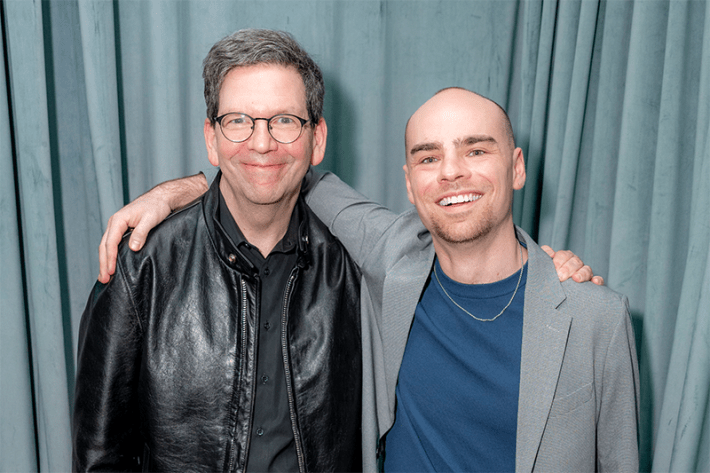
That’s Professor Coffey, a scientist who studies aging, excoriating Silicon Valley billionaires who want to live forever. Coffey is a lead character in a new off-Broadway play, Spare Parts, by David J. Glass, a professor and medical scientist who researches aging at a biotech firm. Provocative and funny, even touching, Spare Parts dramatizes a rash of issues infecting aging research today: public funding getting the ax, libertarian billionaires sinking their riches into medical fountains of youth, and the temptations of scientists to cash in.
“There’s a lot of snake-oil salesmen in the aging field, people who promise you can live 200 years, or even forever,” Glass told me last week. I had asked him what sparked Spare Parts. “These outlandish claims bother me a lot and get in the way of the real science of aging. But the thing that really made me write the play was hearing these rich guys are literally paying for the blood of young people, to have it transferred into them. I felt that was a dramatic metaphor for what’s wrong with society.”
The play begins when Professor Coffey and his assistant arrive at the office of a 64-year-old billionaire, head of a global satellite company. The scientists hope to raise money for aging research from him. The plot turns when the professor’s assistant mentions parabiosis, splicing together the circulatory systems of a young and old animal. The assistant explains that experiments have shown that blood from young mice helped prolong the lifespan of older mice. The professor quickly warns that although that’s true, the blood component involved in helping the older mice has not been determined.
“Who cares what the component is, as long as the younger blood helps,” the billionaire says.
The real parabiotic experiments with mice started more than a decade ago with researchers at the University of California, Berkeley, and Stanford. Results showed the young mice blood boosted cell production in the muscles, livers, and brains of old mice. The utopian interpretation was the young blood reversed hallmarks of aging: the deterioration of cells in muscle tissue and organs. The dystopian version was the muscle and organ cells in young mice showed signs of going from spry to doddering.
“After those results, we weren’t all that interested in young blood as a medicine,” Michael Conboy, a lead scientist of the experiments told Nautilus in 2017. “We need to figure out what in old blood is so detrimental.”
Scientists today have made advances in figuring out what makes blood components detrimental or beneficial in the spectrum of aging. One blood component is currently being tested in trials to treat cognitive impairment in Parkinson’s and Alzheimer’s diseases.
“The mouse experiments did show us that there is something you can reasonably work on to develop a medicine to counter age-related changes,” said Glass, whose specialty is isolating factors that cause us to lose muscle strength as we age. He is also the author of a book on designing proper science experiments, a subject about which he lectures at Harvard. But a few promising experiments don’t substantiate young blood as a medicine for aging. “That’s obviously insane,” Glass said.
In one of those signs of the times the play reflects, companies sprung up after the mice experiments to sell young-blood transfusions to clients—human clients, that is—for thousands of dollars a pop. The most notorious company was Ambrosia, named after the food of the gods that grants immortality. Its founder, Jesse Karmazin, a Stanford-trained physician, told Nautilus in 2017, “A fair number of patients are younger and healthier, and they want to stay that way.”
Young blood didn’t save Ambrosia, which died in 2019. The U.S. Food and Drug Administration took sight of such companies and declared “patients are being preyed upon by unscrupulous actors touting treatments of plasma from young donors as cures and remedies.”
That statement wasn’t the nail in the coffin of young blood clinics. Nor was a 2025 social-media message from Bryan Johnson, who spends millions a year on a fanatic regimen of supposed anti-aging practices and technologies—including transfusing his 17-year-old son Talmage’s blood plasma into his own. But after six transfusions, Johnson, who monitors in his body the many reputed biomarkers linked to longevity, said there were “no benefits detected.” The FDA and Bryan Johnson be damned, companies today like Next Health boast that “Therapeutic Plasma Exchange is currently our most advanced longevity treatment available.” The price: $10,000.
Read more: “The Immortality Hype”
In his 2025 book, Why We Die: The New Science of Aging and the Quest for Immortality, molecular biologist Venki Ramakrishnan, a Nobel laureate in chemistry, underscores the promise of blood therapy as he dismisses the current hype about plasma transfusions on longevity. He takes sight of Silicon Valley and the neon names who have either expressed interest in aging research or invested millions in it—Elon Musk, Peter Thiel, Larry Page, Sergey Brin, Jeff Bezos, and Mark Zuckerberg—and delivers this apercu: “When they were young, they wanted to be rich, and now that they’re rich, they want to be young. But youth is the one thing that they cannot instantly buy.”
Ramakrishnan goes on to write that “if tech billionaires are interested in curing aging in a hurry, many scientists are only too happy to enable them.” In Spare Parts, Glass plants his characters in this ethical swamp. The billionaire in the play says he will pay both the professor and his assistant, Jeff, $1 million a year in salaries if they hook him up to a young blood donor. The professor is offended.
“The money doesn’t mean anything Jeff, if it stops us from doing what we should be doing,” the professor says. “All these great scientists have been taking cash from these guys and then working on nonsense. Nonsense. I want to work on what really matters—so we’ll make progress.”
When Jeff mentions the parabiotic experiment on humans could lead to a paper in Nature, the professor pauses and says, “Of course, if we did get to the paper stage, I’d be senior author.”
Earlier, the professor had explained that a parabiotic experiment would be scientifically valuable only if the mice were identical, “so that if you treat one group with a drug, for example, to see what happens, you can have another group of genetically identical animals who are left untreated, as controls—comparators.”
A plot twist reveals the billionaire’s young executive assistant is genetically identical to him—a clone—making him the perfect blood donor. The billionaire had created a clone of himself for “spare parts,” he explains, “in case I needed something.” Now the professor no longer views parabiosis as nonsense. “I’m actually willing to go ahead now, given the situation,” he says. “I never thought we’d have the necessary comparator for a human experiment. This is amazing.”
I asked Glass what he wanted audiences to make of the professor’s decision. Clearly, cloning another human being for your own salvage is not a good thing. He was showing scientists could be complicit.
Putting his dramatic license aside for a moment, Glass said, he wanted to show his professor character was stuck in a very real predicament for scientists. “He’s been applying for grants and all of a sudden they’re not available. He’s trapped by the system, or lack of a system.” The real cuts to the National Institutes of Health’s budget in the past year have been a terrible blow to research, Glass said, not to mention dispiriting to his student scientists, fearing where they will find a job. Glass decried the specter of science “being run by the whims of our billionaires, as opposed to having a robust public funding of research that everyone has access to do.”
Glass continued. “One thing that really bothers me about a lot of popular culture is scientists are always painted as the enemy or the bad guys,” he said. “I wanted to show scientists are not the bad guys. Scientists are constrained by what’s happening. The professor is constrained by happenstance to do something that he has said is ridiculous. But this is the way for him to get funding for what he actually wants to do.”
Even so, I asked, wasn’t the professor being a hypocrite? “Well, I’ll leave that to you to decide,” Glass said.
Fair enough. After all, Glass is wearing two hats: playwright and scientist. He trained in theater at New York’s Manhattan Class Company and Playwrights Horizon. His previous play, Love + Science, produced in 2023 in New York, circled around two young virologists who fall in love in the 1980s at the beginning of the AIDS crisis. A love affair between the professor’s assistant and the billionaire’s assistant, reeling from the revelation about his identity, also flares in Spare Parts, giving the play an existential sting alongside the science—an admirable feat, I told Glass, weaving science into art.
Glass sounded pleased. “Scientists fall in love, they talk about what makes a person a person,” he said. “We want to do important work, we have egos, we want to get credit in publishing.” As both a scientist and playwright, he said, “I want to show that scientists are also human beings.”
Spare Parts runs through April 10 at Theatre Row, 410 West 42nd St., New York.
Lead photo: Jonny-James Kajoba and Michael Genet in Spare Parts. As their characters Ivan Shelley, an executive assistant, and Zeit Smith, a billionaire, they undergo a blood exchange. Photo by Russ Rowland
Humans Can Read the Expressions and Feelings of Our Primate Cousins
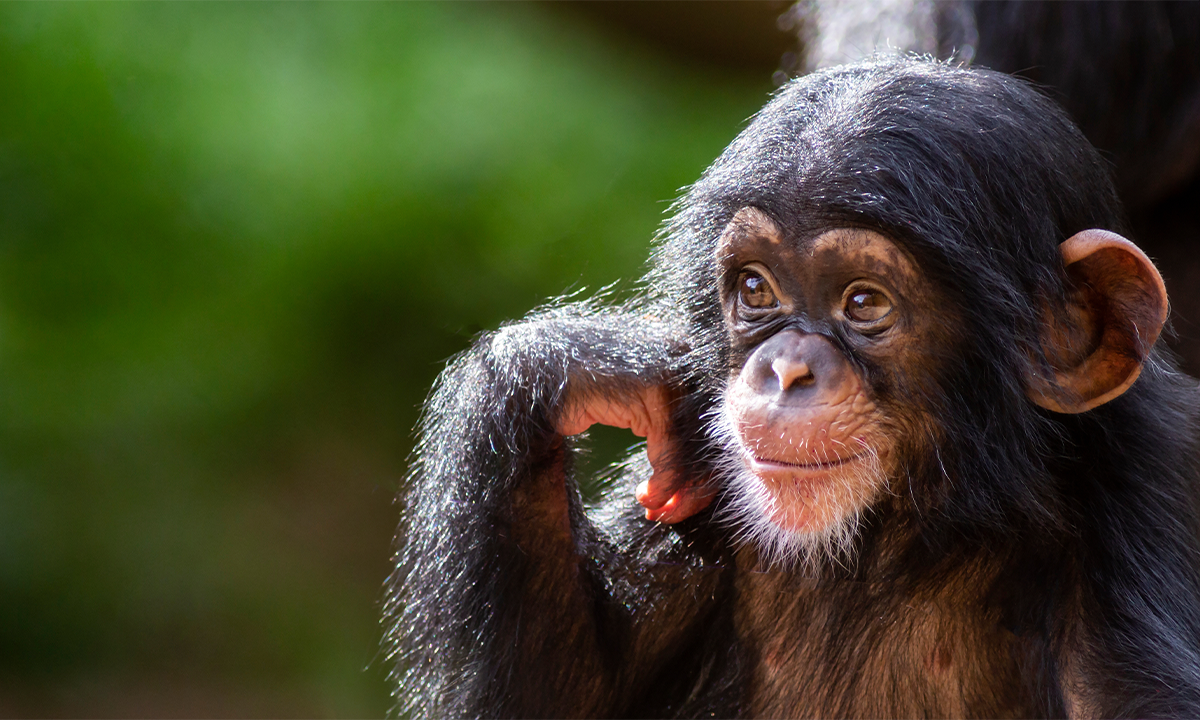
If you’ve noticed the darkening facial expression of your friend as you describe something terrible that happened, you’re witnessing emotional mimicry. Sometimes without even realizing it, we display empathy by mirroring the expressions of others. Non-human primates, such as rhesus macaques, also have been shown to mirror human expressions, in what’s perhaps a show of cross-species empathy. Now, a new study in PLOS One shows that the emotional mimicry between primates goes both ways.
Psychologists from Germany, Italy, and the United Kingdom experimented to determine whether humans would naturally mirror the facial expressions of other primates. A sample of 212 study participants who had no expert experience with other primates watched videos of monkeys and apes making various faces—from threat displays to play faces to neutral expressions. Next, each participant was asked to categorize the primate facial expressions they’d seen as representing positive or negative emotions and rank them relative to happiness, anger, sadness, fear, disgust, and surprise.
Read more: “How a Hurricane Brought Monkeys Together”
The results showed that humans are surprisingly good at diagnosing the facial expressions of non-human primates. The study participants also were adept at associating the faces with emotional labels, like “angry” or “happy,” even though both of those emotions in other primates may include open-mouth displays of the teeth.
“The research suggests that humans are capable of perceiving and resonating with the emotional states of non-human animals,” said the study authors in a press release.
Furthermore, videos of the participants’ own faces as they watched other primate expressions revealed significant emotional mimicry. When the monkey or ape made a negative face, participants tended to make a negative face too, and the converse for happy facial expressions. The strength of the human’s mimicry of other primates depended on how close they felt to each primate—in particular, they felt closer to primates making positive facial expressions.
“By demonstrating the emotional and communicative bridges that connect humans with other animals, we challenge the long-standing divide between species,” explained lead author and Humboldt University in Berlin psychologist Ursula Hess, “and invite a shift in perspective—one that places all living beings at the center of moral consideration.”
So the next time you see another species of primate, be sure to flash it your best friendly smile.
Lead image: Patrick Rolands / Shutterstock
The Science Behind the Perfect 3-Point Shot

In Tuesday’s victory against the Washington Wizards, the Orlando Heat’s Bam Adebayo put up an astonishing 83 points, overtaking Kobe Bryant to claim the record for the second most points scored by a player in an NBA game (Wilt Chamberlain’s god-like 100 points in 1962 remains untouchable). In doing so, Adebayo came dangerously close to notching another, more dubious NBA record: most missed three-pointers. With 15 failed attempts, he was just one air ball away from tying it.
Unless your name is “Steph Curry,” nailing a three-point shot is a tall order. But researchers from the University of Kansas’ Jayhawk Athletic Performance Laboratory are here to help. They recently published a study breaking down the biomechanics of successful three-point shots—and they’ve got a record of their own in their sights.
To investigate what separates a clutch three-point sniper from a bricklayer, they recruited 24 male basketball players—11 of whom were deemed proficient at threes, and 13 of whom were not—and let them take 10 shots from behind the three-point line. The researchers used markerless motion-capture technology to analyze the players’ shooting mechanics, which were recorded by nine cameras around the court.
Read more: “The “Hot Hand” Is Not a Myth”
“What makes this study especially interesting is the use of the DARI markerless motion-capture system, which allows for noninvasive and time-efficient data collection,” study author Dimitrije Cabarkapa said in a statement. Unlike a lot of traditional motion-capture technology, markerless motion capture doesn’t require donning skintight suits with ping-pong balls attached, creating a more natural experience.
They found the key to a successful three was all in the setup. Analysis of the tape revealed successful three-point shooters had a greater bend in their hips, knees, and ankles, which allowed them to lower their center of mass prior to releasing the ball. “Having a wider stance is very important for stability,” Cabarkapa explained. “Without that, a shooter cannot maintain a stable base and is going to be off-balance.”
The team hopes to apply the lessons learned from this research to help break the Guinness World Record for most consecutive three-point shots by partnering with Cornell Jenkins, a college basketball player turned physicist. Jenkins can routinely hit 30 to 40 three-pointers in a row—well short of the record—and hopes to improve with real-time analysis by the team.
“This is where science meets practice,” Cabarkapa said. “We’re refining everything we do in order to better understand each factor that can optimize athlete performance. We’ll help Cornell monitor his progress and implement innovative technology to objectively assess his performance and advancement toward achieving this goal.”
If Jenkins wants his name in the record books, he’ll have to top Fred Newman’s record of 209 consecutive three-pointers from the college three-point line. Of course, he could also try for more than 105 consecutive three-pointers from the NBA line. That record is held by, you guessed it, Steph Curry.
Lead image: Jag_cz / Shutterstock
How Flowers Transformed Planet Earth

The birth of perfume is often traced to a city called Grasse in the south of France, which was known for leather tanning in the Middle Ages. In the 16th century, some leatherworkers there began using oils steeped in flower aromas to impart scent to gloves. These perfumed gloves, boosted by the queen of France, Catherine de Medici, became fashionable with the royalty and nobility in Europe. King Louis XIV became known as “le doux fleurant” (the gentle, sweet flowery one) for his love of perfume. Soon the perfume market replaced the tanneries in Grasse and today the town is almost universally recognized as the world’s perfume capital. This is just one of many stories about flowers that David George Haskell recounts in his new book How Flowers Made Our World: The Story of Nature’s Revolutionaries.
But as Haskell points out, the origins of perfume are actually so much older than the scented gloves from Grasse. Bees and other pollinators have been using the aromas of flowers to scent themselves—and woo mates—for eons, he writes. Haskell’s larger argument is that flowers are neither as ephemeral nor ornamental as we often think. Both in the evolution of life on this planet, and in human culture, flowers have been a critical engine of connection and cooperation, Haskell writes.
The book is part travelogue, part history, part ecology, part manifesto: He wants humans to change our relationship to the natural world—from a posture of domination and control to one that honors our interdependency with the many forms of life—plant, animal, and microbe—around us. This, Haskell believes, is the prerequisite to solving huge, existential problems: not just climate change and environmental destruction, but also political conflict and instability around the world.
“Garden design and the tending of flowers seem, at first, sideshows, perhaps even decadent distractions, in the face of the mounting crises of our world,” he writes. “Yet, crisis demands radical cultural change.” I talked with Haskell about why he sees flowers as revolutionaries, why humans are a “floral species,” and whether their rise in the evolutionary history of Earth is still an “abominable mystery,” as Darwin once put it.
You call flowers “revolutionaries” in the title of your book. Why did you choose that word to describe them?
These creatures opened massive possibilities as they evolved, not just for themselves, but for other creatures. They transformed the foundation of life on Earth. For example, there were no rainforests before there were flowering plants. There were no prairies. These really important ecosystems could not exist without flowering plants. They also had a biophysical effect on the entire climate. One of the things flowering plants did was increase the productivity of what is known as transpiration, the movement of water from the soil into the air.
Biologists call the time when flowering plants evolved the Cretaceous terrestrial revolution. But I think that's too modest because, for one thing, flowering plants revolutionized the world after the Cretaceous period. And it wasn't just on land. When you look at the edges of the continent, seagrasses and mangroves and salt marshes, some of the most important habitats in terms of climate regulation and nurseries for sea fishes and invertebrates are made by flowering plants. Some of these flowering plants actually make their flowers underwater in the salt water, which to me is kind of mind-blowing.
I also like the word revolutionary because it has a particular cultural meaning within human societies that flowering plants subvert. We often think of human revolutions as being violent, whereas flowering plants use beauty and cooperation and illusion. I mean, there's a fair amount of deception happening with flowers and their relationships to others, which I find interesting and deliciously complicated. So reframing what revolution is, I think is an interesting idea.
The book positions humans as "a floral species." Can you unpack what you mean by that: How are humans fundamentally shaped by flowers?
There are two main ways in which I mean that, and one is that humans would not exist without flowering plants. We're primates and the first primates evolved to climb up trees and eat fruits and eat the insects that are feeding on flowering plants. Primates probably wouldn't have evolved without flowering plants. But more recently, our hominid ancestors came out of the forest. We came down from the trees into the savannas and grasslands. And grasslands are habitats built entirely by flowering plants. Grasses are one very specialized and hugely successful group of flowering plants. It was the evolution of grasses that created opportunities for our ancestors to become bipedal and to depend on the big animals that ate those grasses. We really were a grassland species for millions of years.
That continues to the present day after the agricultural revolution in many parts of the world because the foundational foods of human agriculture are grasses: maize, rice, and wheat form 60 percent of all calories that we eat. Sugar cane, barley, millet, these are all other grasses that are really important.
I kind of jokingly write in the book that if we named ourselves for the food that we eat, we'd be the grass apes, Homo poaceae. We really don't think of ourselves as completely dependent on grass, but our relationship with flowering plants like grasses is what catalyzed the evolution of humanity and sustains us today.
There's a second way in which we're a floral species, and this is not about how we evolve or what we eat, but how we express ourselves and how we relate to one another. When we bury somebody, we often bring flowers to the grave or the funeral. When we are wooing someone, we offer a bouquet. When people get married, there are showers of petals. In many religious traditions, flowers are brought to the altar or are used in worship. And of course, we spend a lot of time gardening and devoting our labor to making flowering plants happy. When we want to express our individuality, we perfume ourselves often with the aromas of flowers.
Read more: “Why Is Everything an Orchid?”
Darwin famously called the sudden appearance and dominance of flowering plants an “abominable mystery.” Does your book offer a resolution to Darwin's puzzle, or does the mystery remain abominable?
You’ve got to love Darwin for his spirited expression. That quote comes from a letter to British botanist Sir Joseph Dalton Hooker, who lived at the same time as Darwin in England. Darwin was just despairing. Why did flowering plants suddenly explode onto the scene late? Why and how?
There is still mystery, though it's not quite such an abomination. Back in Darwin's time, in the late 1800s, they had discovered few fossils. Now we've got a much more fine-grained view. We have some early fossils from almost 130 million years ago, and we can piece together the evolution of some of the early groups of flowering plants. But the fossil record for flowers is still poor because flowers are so delicate.
The other thing that Darwin didn't know about, of course, was modern genetics, and that helps to shine a big spotlight onto the mystery. We now know that flowering plants appeared quite suddenly. They evolved and then 10 million years later, they'd taken over a lot of the planet and many of the major groups of flowering plants were already established. How did they do that?
One way is through genetic storms, where you observe the doubling of the entire genome or doublings of huge chunks of the genome, which provides massive amounts of raw material for evolution to play with. So instead of having just two copies of every gene, suddenly these plants have four or six copies. And the two of them can just do the work of running the plant. That means you've got extras that can mutate and evolve new aromas or come up with new ways of building xylem, the vascular tissue that transports water and minerals from the roots to the stems and leaves. Essentially it's this big party, almost like a rave, where all this experimentation is happening.
What geneticists have discovered is that before the evolution of flowering plants, there was one such genetic storm. And then there have been others repeatedly through time that have increased diversity and allowed plants to make it through really challenging times. And these genetic storms are still happening today. Scientists have studied them in the field and in the lab. I think if Darwin knew about this, he would be really excited.
You mention that flowers shaped modern science in ways both "marvelous and, sometimes, unjust." Can you elaborate on the unjust aspects?
It's more than unjust, it's horrifically wrong. This is a story that centers mostly on Carl Linnaeus, who is the biologist who in the 1700s came up with the method of classification of life that we still use today.
Linnaeus was totally obsessed with flowering plants. He collected them. He studied them. He came from a quite poor background and in many ways was self-taught in his botanical knowledge. And he developed his classification scheme first based on studying flowering plants.
To this day, botanists still root all of the original scientific names of plants back to Linnaeus. Of course, many of them have been updated and Linnaeus had lots of the relationships and the families wrong. But he produced a classification of orders and families and species and so on based on flowers.
He then applied that classification to other species, to animals, including humans. And in a way, he was fairly progressive in that he regarded humans as actual animals. He classified us within the primates, which, you know, biologists would agree with that.
Unfortunately, he also, within humans, divided humans into different groupings. And he did it according to what we would now call race. He used very simple sort of color classifications, and then ascribed particular moral and behavioral characters to different races. And being a white guy, he thought the whites were the smartest and most morally upright.
Because he was so well known and was regarded as the living authority on classifying life, that classification, which is completely not based on any evidence whatsoever, then became part of the foundation of modern biology. So the study of flowers revolutionized not just the scientific study of biology in ways that I would argue are quite useful, but also, unfortunately, put some white supremacist racist ideas into the founding documents of the science of biology.
We see modern manifestations of this happening now all the time. People misuse scientific terms and scientific ideas to put a veneer of objectivity on fundamentally non-scientific and racist ideas.
Flowers essentially seduced their pollinators. They used beauty to transform enemies into allies. You write that this teaches us something fundamental: that "thriving worlds grow from cooperation, mediated by beauty." That's such a provocative idea. How do you see beauty functioning as a mediator beyond the plant world?
I taught undergraduates for many decades and it struck me how little we talk about beauty in the science classroom. I think that's problematic because we can pretend that we're not motivated by beauty, but we're deceiving ourselves. A deep experience of beauty is when our intellects, our emotions, our senses, everything we've learned from our culture all come together to produce a really deeply moving, informative experience that guides us. It guides our intellect, it guides our emotions, it guides our values. It can be a foundation for ethics. I think that's worth talking about in the classroom.
In some of my previous books, I developed this idea about ethics and beauty a little more. But I think flowers are a powerful example of how beauty is not just this ephemeral fuzz in animal minds that just goes away. No, experiences of beauty are catalytic, they're creative, they build ecosystems, and they could potentially be deeply informative if we were to pay attention to them.
There's a thread in the book about how shifting our relationship with flowers can help us solve some of the world's toughest problems. That feels like a big leap—from tending to a rose to addressing environmental problems like climate change. Can you unpack that connection for us?
I would flip that around and ask, if we are not in living embodied relationships with other creatures on the planet, what hope have we got of being good neighbors and kin? The foundation of right action has to be a lived relationship. And the nature of that relationship can be really different for different people.
If I was sitting on the board of a timber corporation, for example, I would think it would be the responsibility of board members to spend time in the forests that they're making decisions about. Not because the forest is going to somehow mysteriously speak to you and tell you the answer. But if all you're looking at is spreadsheets, you are cutting yourself out from all the sensory data that is coming in from thousands of species that live in the forest. And this is one reason why forests are in crisis today. Forest managers, whether from timber corporations or big multinational conservation groups, have almost no lived experience in the ecosystems that they're presuming to manage. And so, if we want to be good stewards and kin and neighbors to the living earth community, we have to have practices of getting outside, getting off our screens, getting our hands in the soil.
Most of us are not sitting on the board of timber corporations, but we do have the possibility of putting a window box out or tending our backyard or belonging to a community garden. And alone, those actions are not going to solve all of the world's problems. Of course not. So they're not sufficient, but they are necessary. Because I think if we are trying to solve problems by just locking ourselves in seminar rooms under fluorescent lights, we are not going to be coming up with the right answers to how to live well on this planet.
Lead image: habibur383 / Shutterstock