Universe Today

This Newborn Planet Is Carving Out A Home In Its Protoplanetary Disk

by: Evan Gough (https://www.universetoday.com/authors/ion23drive)

This Newborn Planet Is Carving Out A Home In Its Protoplanetary Disk

On the left is a disk and a candidate planet around the star HD 135344B as seen with ERIS. On the right is a joint VLT and ALMA view of the disk. The planet is carving spiral patterns in the disk. Image Credit: ESO/F. Maio et al./T. Stolker et al./ ALMA (ESO/NAOJ/NRAO)/N. van der Marel et al.

Around three decades ago, we weren't certain that other stars had planets orbiting them. Scientists naturally thought there would be, but they had no evidence. Now, not only do we know of more than 6,000 confirmed exoplanets, but we can watch as baby planets take shape around distant stars.

When stars form, they're surrounded by rotating disks of gas and dust called protoplanetary disks. Planets form in these disks, and in recent years, ALMA (Atacama Large Millimeter/submillimeter Array has examined many of these disks. It's made headlines by finding telltale signs of planets forming, as they seem to clear orbital paths in the disks.
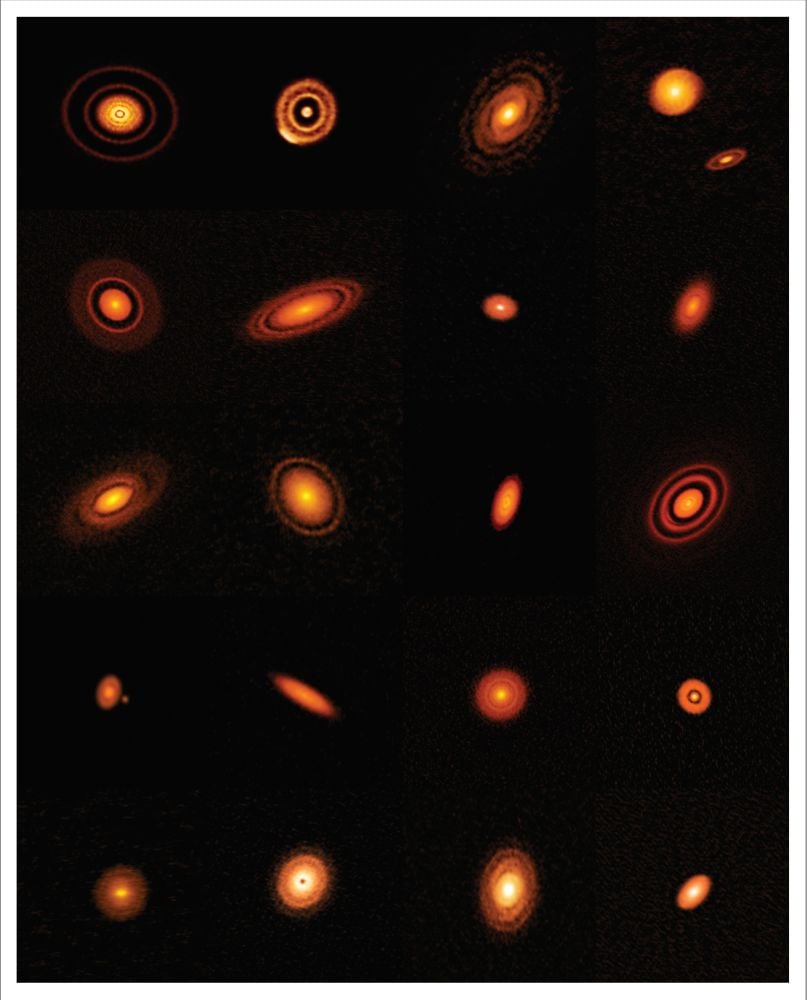
This image shows some of the protoplanetary disks imaged by ALMA. The gaps and rings show where planets are forming and creating lanes in the gas and dust. Image Credit: ALMA (ESO/NAOJ/NRAO), S. Andrews et al.; NRAO/AUI/NSF, S. Dagnello This image shows some of the protoplanetary disks imaged by ALMA. The gaps and rings show where planets are forming and creating lanes in the gas and dust. Image Credit: ALMA (ESO/NAOJ/NRAO), S. Andrews et al.; NRAO/AUI/NSF, S. Dagnello

Other telescopes have studied these young protoplanetary disks, too, and uncovered their own evidence of planets forming. Astronomers working with the ESO's Very Large Telescope (VLT) and its SPHERE instrument found spiral arm patterns in the disk around the star HD 135344B. While those patterns suggest the presence of a planet, there was no direct evidence.
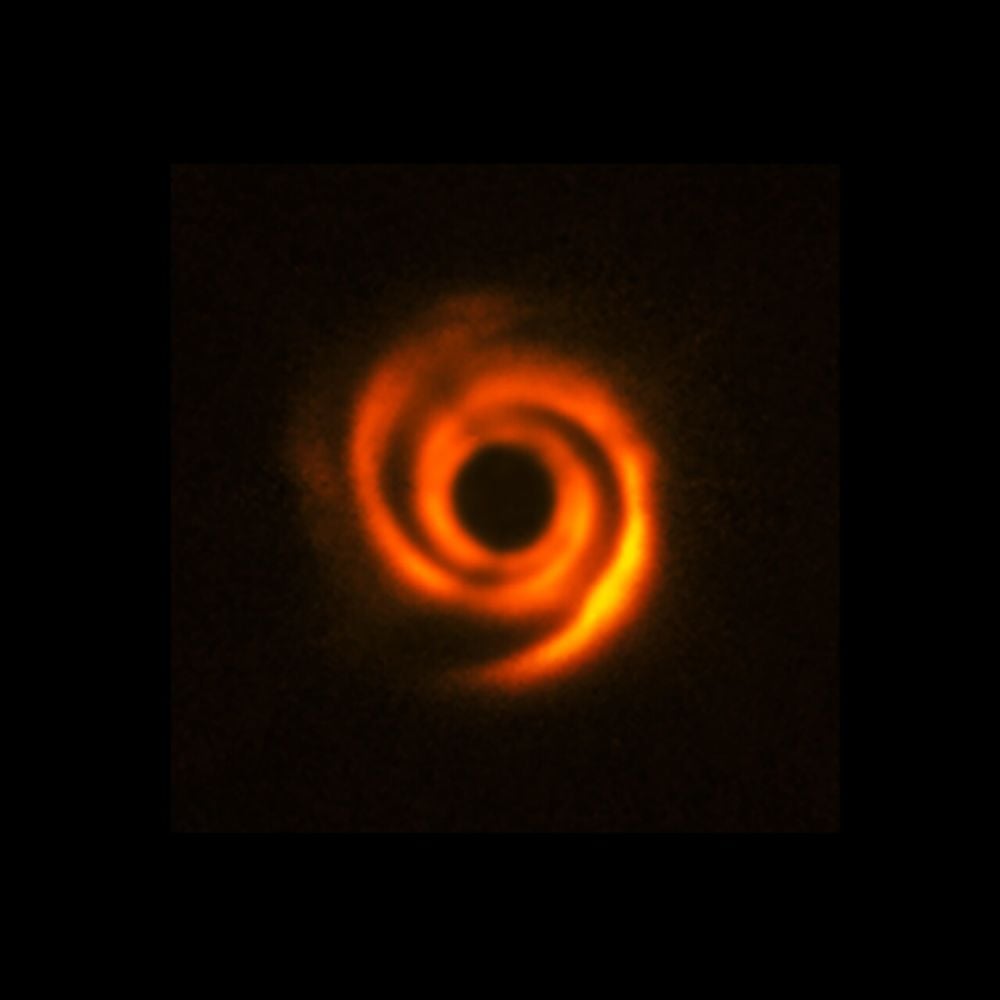
The SPHERE instrument on the ESO's Very Large Telescope observed these spiral arm patterns around HD 135344B. This instrument suggested the presence of a planet, but didn't provide any direct evidence that one was there. The central black region shows how the star itself is blocked by the telescope's coronagraph. Image Credit: ESO/T. Stolker et al. The SPHERE instrument on the ESO's Very Large Telescope observed these spiral arm patterns around HD 135344B. This instrument suggested the presence of a planet, but didn't provide any direct evidence that one was there. The central black region shows how the star itself is blocked by the telescope's coronagraph. Image Credit: ESO/T. Stolker et al.

Now astronomers working with another of the VLT's instruments, the Enhanced Resolution Imager and Spectrograph, may have found direct evidence of a gas giant forming around the star. The discovery is presented in a research letter titled "Unveiling a protoplanet candidate embedded in the HD 135344B disk with VLT/ERIS" published in Astronomy and Astrophysics. The lead author is Francesco Maio, a doctoral researcher at the University of Florence, Italy.

"High-angular-resolution observations in infrared and millimeter wavelengths of protoplanetary disks have revealed cavities, gaps, and spirals," the authors write in their research. "One proposed mechanism to explain these structures is the dynamical perturbation caused by giant protoplanets."

Previous research examined the disk around HD 135344B. ALMA observations revealed spiral arms and hints of a massive planet forming, and other features like a blob. This research has refined those observations with more powerful instruments.

"We identified the previously detected S1, S2, S2a spiral arms and the “blob” features southward of the star," they added. They also found a new point source at the base of the S2 spiral arm. They identify it as a gas giant with about 2 Jupiter masses.
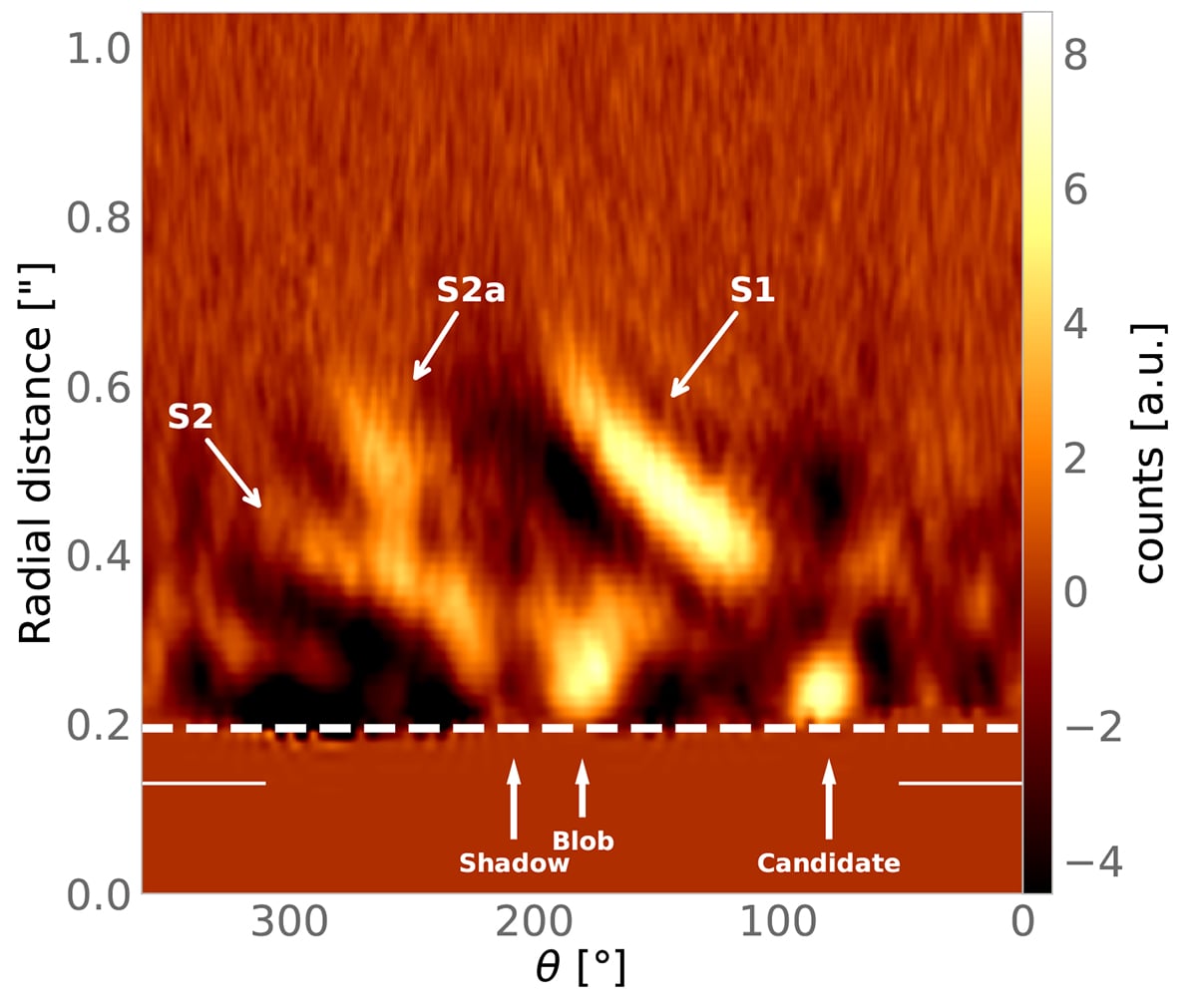
This figure shows the two spiral arms and the candidate companion. The shadow, marked by the arrow, is also evident, along with a fully shadowed region highlighted by the horizontal solid line. This visualization of the shadows further confirms the extended nature of the blob south of the star and highlights that it is part of the S2 spiral interrupted by the shadow. Image Credit: Maio et al. 2025. A&A This figure shows the two spiral arms and the candidate companion. The shadow, marked by the arrow, is also evident, along with a fully shadowed region highlighted by the horizontal solid line. This visualization of the shadows further confirms the extended nature of the blob south of the star and highlights that it is part of the S2 spiral interrupted by the shadow. Image Credit: Maio et al. 2025. A&A

These observations are markedly different from previous observations showing the telltale gaps carved out by exoplanets. With those images, researchers could only deduce that planets created them. And when it comes to spirals, there were other potential explanations, too. "Spiral arms can also be explained by other mechanisms not involving an external perturber," the researchers write, explaining that gravitational instability could potentially create the arms, as could shadows. A 2021 paper explained that asymmetries in circumstellar disks can cast shadows on other regions of the disk. Those shadows create regions of low pressure that could trigger the formation of spirals.

But this time, astronomers have detected light signals from the planet itself.

“What makes this detection potentially a turning point is that, unlike many previous observations, we are able to directly detect the signal of the protoplanet, which is still highly embedded in the disc,” says Maio, who is based at the Arcetri Astrophysical Observatory, a centre of Italy’s National Institute for Astrophysics (INAF). “This gives us a much higher level of confidence in the planet’s existence, as we’re observing the planet’s own light.”

This system is 440 light years away, and the planet is about twice as large as Jupiter. It's about as far away from its star as Neptune is from the Sun (~4.5 billion km).

A different group of researchers have also discovered spiral arms in the disk around another star. It's named V960 Mon, and the researchers used the ERIS instrument on the VLT to observe it. They say they discovered a companion object forming in the disk, and their discovery is in The Astrophysical Journal Letters. It's titled "VLT/ERIS Observations of the V960 Mon System: A Dust-embedded Substellar Object Formed by Gravitational Instability?" and the lead author is Anuroop Dasgupta from the European Southern Observatory.

"V960 Mon is an FU Orionis object that shows strong evidence of a gravitationally unstable spiral arm that is fragmenting into several dust clumps. We report the discovery of a new substellar companion candidate around this young star," the researchers report. It's deeply embedded in the disk, and is close to some previously reported clumps in the disk around V960 Mons. "This candidate may represent an actively accreting, disk-bearing substellar object in a young, gravitationally unstable environment," they write.

The object could be one million years old and have 660 Jupiter masses.
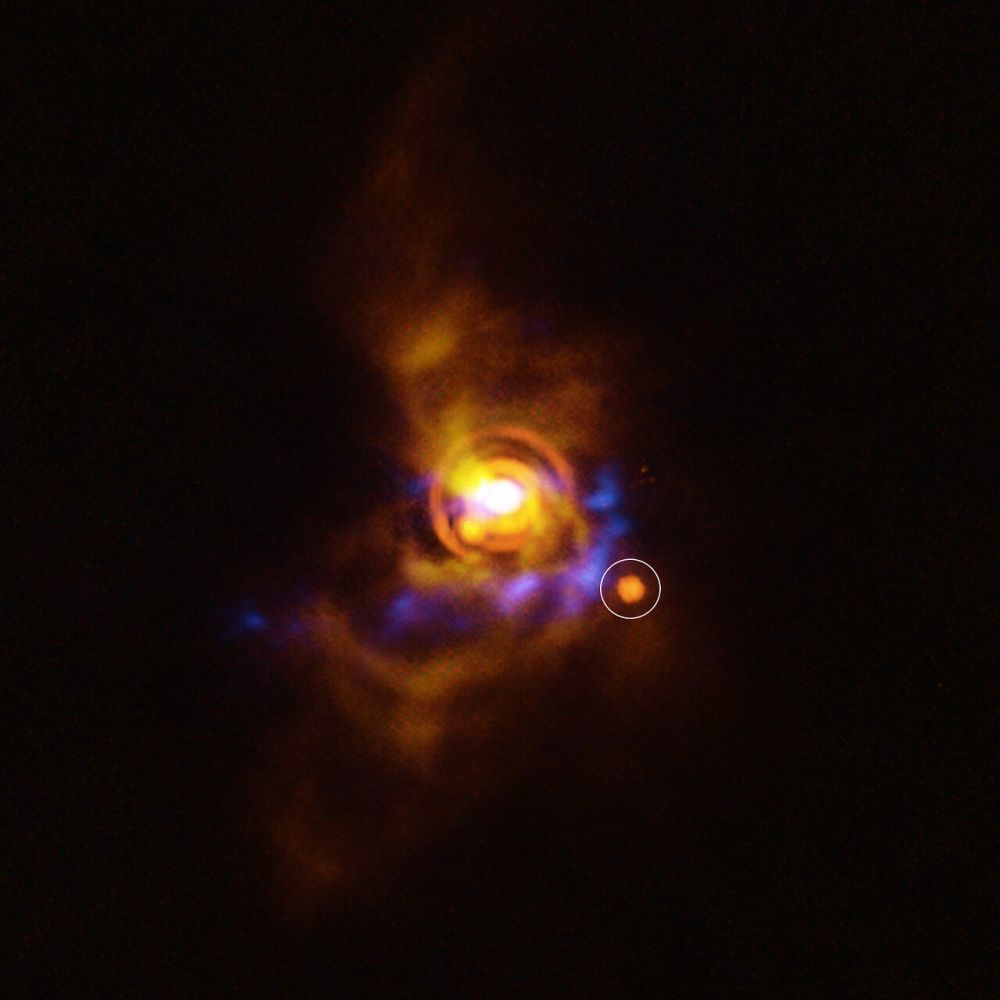
This image shows a possible companion orbiting the young star V960 Mon. Previous analysis of the disc showed that it contains clumps of unstable material that could collapse to form a companion object. The new candidate found here could be either a planet or a brown dwarf. Image Credit: ESO/A. Dasgupta/ALMA (ESO/NAOJ/NRAO)/Weber et al. This image shows a possible companion orbiting the young star V960 Mon. Previous analysis of the disc showed that it contains clumps of unstable material that could collapse to form a companion object. The new candidate found here could be either a planet or a brown dwarf. Image Credit: ESO/A. Dasgupta/ALMA (ESO/NAOJ/NRAO)/Weber et al.

This work adds to previous research that identified spiral arms around V960 Mons. That research also found clumps that could be portions of the spiral undergoing gravitational instability and possibly forming planets. "Estimating the mass of solids within these clumps to be of several Earth masses, we suggest this observation to be the first evidence of gravitational instability occurring on planetary scales," those authors wrote.

That research set the stage for Dasgupta and his co-researchers to search for and find more direct evidence of a companion forming in the disk.

“That work revealed unstable material but left open the question of what happens next. With ERIS, we set out to find any compact, luminous fragments signaling the presence of a companion in the disc — and we did,” says Dasgupta. However, they aren't sure if it's a planet or a brown dwarf.
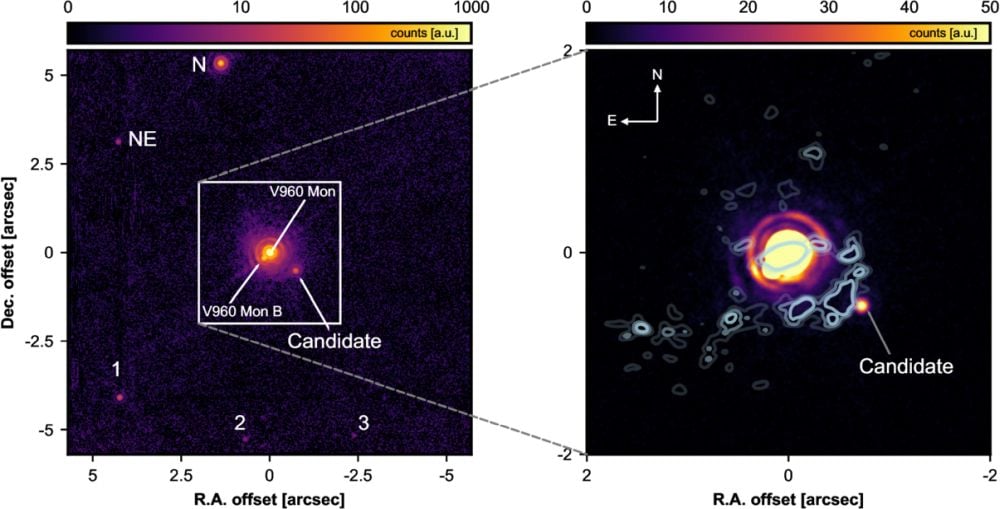
This is a VLT/ERIS image of V960 Mon. The left panel shows the binary star embedded in its environment, marking the detection of V960 Mon N and V960 Mon NE. The right panel shows a zoom-in onto V960 Mon, overlaid with ALMA contours, and the candidate object. Image Credit: ESO/A. Dasgupta/ALMA (ESO/NAOJ/NRAO)/Weber et al.* This is a VLT/ERIS image of V960 Mon. The left panel shows the binary star embedded in its environment, marking the detection of V960 Mon N and V960 Mon NE. The right panel shows a zoom-in onto V960 Mon, overlaid with ALMA contours, and the candidate object. Image Credit: ESO/A. Dasgupta/ALMA (ESO/NAOJ/NRAO)/Weber et al.*

This detection is important because if it's confirmed, it could be the first direct evidence of planets forming through gravitational instability (GI). The core accretion theory is more widely accepted, but gravitational instability could better explain how Jupiter mass planets could form quickly, and further from their stars.

These two systems and their spirals are linked with GI. Astronomers think they support the GI formation model, but differentiating between the two processes in distant disks is challenging.

The quest to observe planets as they're still forming is linked to our strong desire to understand how our planet formed. Intellectual curiosity drives us to look at our surroundings and wonder how everything got this way. There are many unresolved questions about how Earth formed, and by watching as other planets form, we may be able to uncover some answers.

“We will never witness the formation of Earth, but here, around a young star 440 light-years away, we may be watching a planet come into existence in real time,” said Maio.
Is It Worth Going Back to the Moon?

by: Paul Sutter (https://www.universetoday.com/authors/pmsutter)

Is It Worth Going Back to the Moon?

None
None

It is true that crewed missions to the Moon are expensive, difficult, and dangerous. And we now have a long history going back decades of reliable, dependable, capable robotic exploration, including fly-bys, orbiters, landers, and rovers. Why don’t we look at how much human spaceflight would cost to return to the moon, and just spend that money on lots of robots instead?

The answer is that no matter how dependable and capable out little robotic explorers are, they just can’t match what a human can do. Compared to a robot, a human is stronger (at least, stronger than the kinds of robots we can send to the moon), can troubleshoot and solve problems much faster without guidance from Earth-based engineers, are much more creative and flexible when it comes to scientific investigation, are much, much faster moving around, are much more versatile and dexterous. I mean, a typical rover speed is around 0.1 mph, or a blazing 152 meters per hour (insert obligatory joke about old people driving on freeways here).

Humans are just…better in almost every aspect. The typical benchmark is that what a robot can do in an entire day a human can accomplish in a minute. But the downsides of course are that sending humans is much more expensive and much riskier. Except for a few engineers nobody sheds a tear when a robot crash lands on the surface. And a crewed mission is going to be AT LEAST ten times more expensive than an equivalent robotic mission.

But while human missions are more expensive, their productivity totally eclipses that. The Apollo missions spent a total of 12.5 contact days on the Moon, which resulted in nearly 3,000 scientific papers. Compare that to the thousand or so papers written about Mars from YEARS of rovers and landers on its surface. On a cost-per-science-result basis, we’re stupid to NOT keep sending humans into space.

But science isn’t the only reason to send humans to the Moon. The moon has a lot of easily accessible resources that could provide the basis for space-based industry. Mining and manufacturing on the moon could use rich deposits in methane, ammonia, and atomic oxygen in the lunar regolith. These operations could funnel back either manufactured or refined materials to Earth, or become the backbone of further off world industry as a steady supply of water and fuel. The Moon has a much shallower gravitational well than the Earth, meaning that it’s easier to come and go from the surface. You could build advanced rocket parts or habitats and get them out to Mars or the Asteroid belt (or anywhere else in space) far, far easier than doing the same thing on the Earth.

And while for now we can fantasize about fully automated factories or mining operations on the lunar surface, the truth is that we don’t have nearly the experience or expertise to develop those kinds of systems outside of the Earth. Lunar manufacturing and mining is a long way off: we have to figure out how mining and machining can operate in low gravity, we have to figure out how to deal with all the super-fine lunar dust, we have to figure out how to haul all that mining gear out there, and we have to figure out where all the good stuff is on the Moon in the first place, otherwise we’ll waste our time digging up just more regolith. So to kickstart this process we’re going to need a lot of humans doing a lot of grunt work.

Lastly, it’s just fun. Humans are natural explorers. Long ago we expanded into every habitable biome of the Earth, making our way across ice bridges and over the horizons of endless seas to find new homes. It’s in our nature to explore and expand. The Moon is…right there, waiting for us. We spent millennia thinking it was just a mysterious part of the heavens. Now we understand that it’s a world in its own right, a place to plant our flags and build our homes, a place where a branch of humanity could potentially create communities.

There is always going to be a segment of the population that separately wants to go to the Moon just for the adventure of it and the desire for a new life. It's not crazy to imagine humanity building cities and homesteads on the lunar surface. It may take a very long time, but it’s not impossible. If those people are private individuals spending their own money, then good for them. If it’s publicly-funded institutions like NASA footing the bill, then let’s keep in mind that the entire space program of the United States takes up less than a percent of the total federal budget. In other words, we’re barely spending any money on it at all.

How the Moon’s Hidden Protection Shields Against Solar Wind Erosion

by: Mark Thompson (https://www.universetoday.com/authors/mark)

How the Moon’s Hidden Protection Shields Against Solar Wind Erosion

Despite the wonderful images captured from the lunar surface that suggest otherwise, the Moon does have an atmosphere. It's an incredibly thin, rarefied shell of gas known as an exosphere. (Credit: NASA)

The Moon's thin atmosphere, called an exosphere, has been a puzzle to science for some time. Two main processes were thought to create this wispy gas envelope; tiny meteoroids hitting the surface and solar wind particles bombarding the lunar soil. But new research using Apollo moon samples reveals that the Moon's own surface features provide surprising protection against solar wind erosion.

Researchers at TU Wien and the University of Bern conducted the first direct measurements of solar wind ejecting atoms and molecules when striking the lunar soil, a process known as sputtering. Unlike previous studies that relied on Earth based mineral substitutes, the team used Apollo 16 Moon dust and bombarded it with hydrogen and helium ions at solar wind speeds.

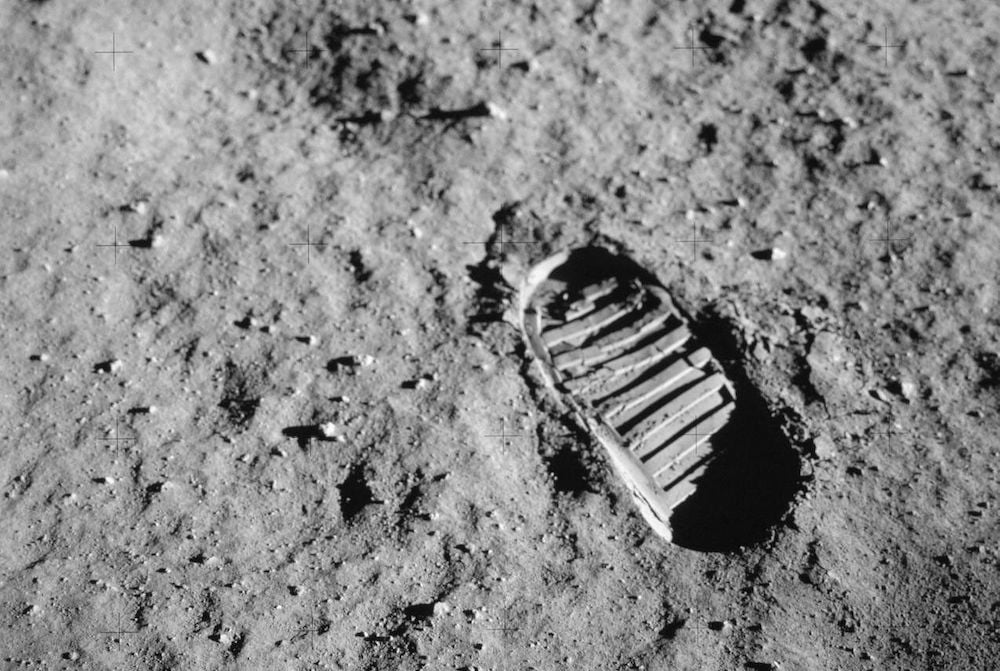
Neil Armstrong's footprint immortalised in the soft, powdery lunar regolith (Credit : NASA) Neil Armstrong's footprint immortalised in the soft, powdery lunar regolith (Credit : NASA)

The results were striking. Solar wind sputter yields were up to an order of magnitude lower than previously used in exosphere models. This dramatic reduction comes from two key factors that previous models had underestimated, surface roughness and the porous, fluffy nature of lunar soil.

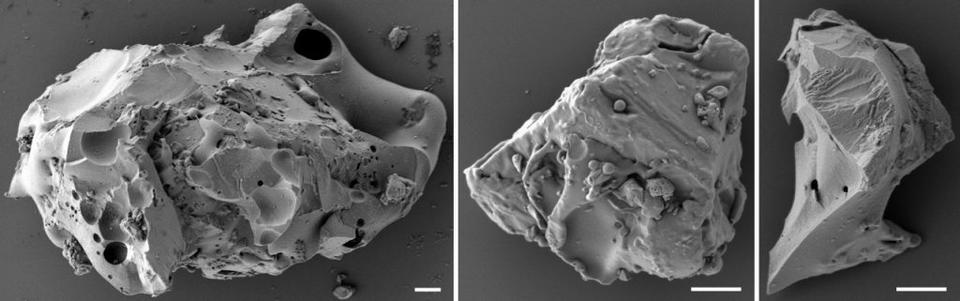
The Moon's surface isn't smooth like a billiard ball, it’s incredibly rough and porous at the microscopic level. This texture acts like a natural shield against solar wind bombardment. When ions hit the jagged, crater-filled landscape, many get trapped in tiny pockets or strike surfaces at angles that reduce their erosive power.

Micrographs of three particles of moon dust collected during the Apollo 11 mission in 1969. The montage showcases the vast differences seen within a sample. The scale bars are all 1 micrometer. The images were made with a scanning electron microscope at NIST. (Credit : Chiaramonti Debay/NIST) Micrographs of three particles of moon dust collected during the Apollo 11 mission in 1969. The montage showcases the vast differences seen within a sample. The scale bars are all 1 micrometer. The images were made with a scanning electron microscope at NIST. (Credit : Chiaramonti Debay/NIST)

The high porosity of lunar regolith further reduces sputter yields, with the combined effects of roughness and porosity making erosion rates largely independent of the solar zenith angle. This means the protective effect works across most of the Moon's surface, regardless of latitude.

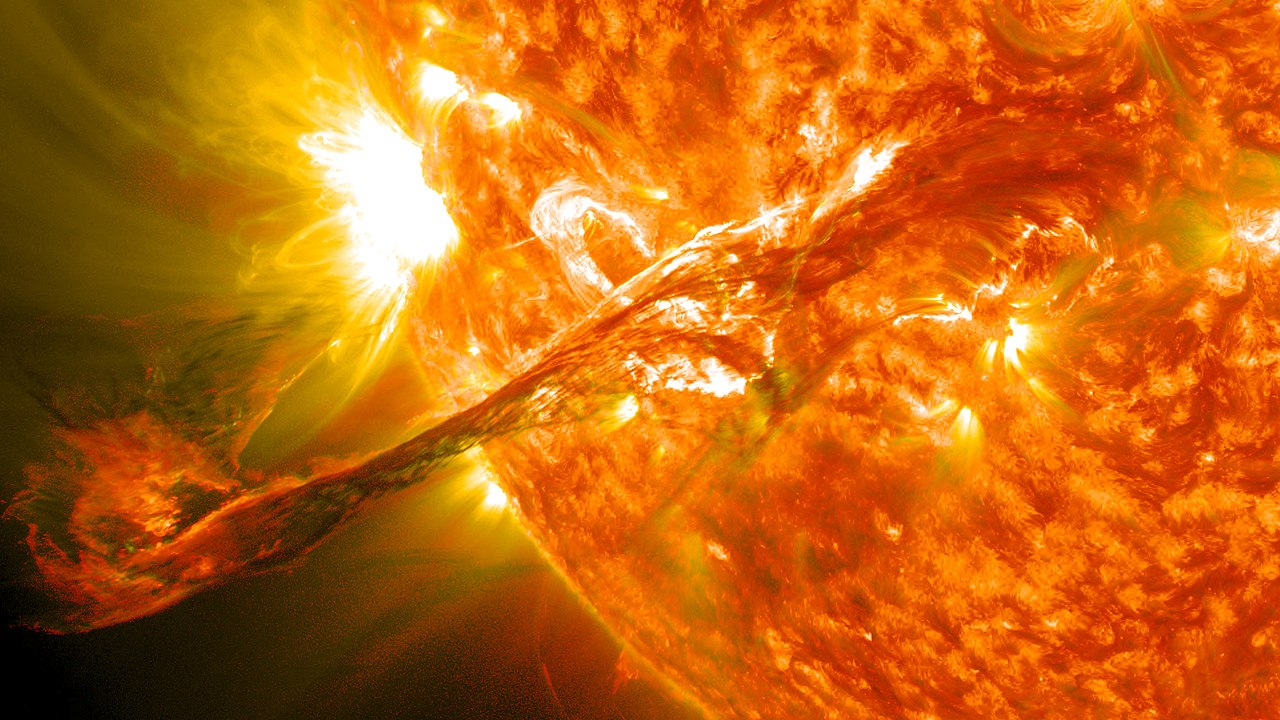
An eruption on the Sun, the source of the solar wind. (Credit : NASA Goddard Space Flight Center) An eruption on the Sun, the source of the solar wind. (Credit : NASA Goddard Space Flight Center)

The research team created three dimensional computer simulations of the lunar surface structure, complete with the spaces between dust grains. These models revealed that the Moon's natural "fluffiness" dramatically reduces the number of atoms knocked loose by solar wind impacts.

These findings change our understanding of how the Moon loses material to space. The study provides realistic sputter yield estimates which are ten times smaller than previous estimates! This suggests that micrometeoroid impacts, rather than solar wind sputtering, are likely the dominant source of the Moon's exosphere. The tiny space rocks that constantly pepper the lunar surface may be doing most of the work in creating the Moon's thin atmospheric envelope.

Understanding how solar wind interacts with airless planetary surfaces is crucial for upcoming missions, including NASA's Artemis program and the European Space Agency's BepiColombo mission to Mercury. As for the atmosphere of the Moon, the study helps explain why previous space observations didn't match theoretical predictions. The Moon's surface has been protecting itself all along, we just needed the right tools and real lunar samples to see how.

Source : Solar wind erosion of lunar regolith is suppressed by surface morphology and regolith properties

Apparently Vera Rubin Captured Images Of 3I/ATLAS Before It Was Even Discovered

by: Andy Tomaswick (https://www.universetoday.com/authors/andy-tomaswick)

Apparently Vera Rubin Captured Images Of 3I/ATLAS Before It Was Even Discovered

High resolution image of interstellar visitor 3I/ATLAS, captured by the Vera Rubin observatory on July 3rd. Credit - C.O. Chandler et al.

Sometimes serendipity happens in science. Whether it’s an apple falling from a tree or a melting chocolate bar, some of the world’s greatest discoveries come from happy accidents, even if their stories may be apocryphal. According to a new paper on arXiv, there’s a new story to add to the archives of serendipitous scientific discoveries - Rubin happened to make observations of interstellar object 3I/ATLAS before its official discovery, while the telescope was still in its Science Validation survey, marking the earliest, high resolution images we will likely get of the comet at that time.

According to the paper, Rubin just happened to be pointing at the part of the sky where 3I/ATLAS was located during its Science Validation (SV) phase. It unknowingly took pictures of the object between June 21st (10 days before it was officially discovered) and July 7th. June 21st was even a few days before the telescope officially released its “First Look” images to the public back on June 23rd.

These observations are important because they are the earliest ones done by a high power telescope. Rubin’s 8.4m Simoyi Survey Telescope and 3.2-gigapixel Legacy Survey of Space and Time (LSST) combined to capture the highest resolution images of the comet released to date. Since the images were captured before full commissioning, the data they represented had to be run through customer data pipelines rather than the standard automated ones that will handle the terabytes of data normally created by Rubin every night.

Fraser discusses the new interstellar object, 3I/ATLAS.

There were 49 images included in the study, though some were excluded due to being captured during telescope alignments, blending with other stars, or just being out of focus. Nineteen of the images were captured during intentional SV operations.

Those images show a comet that largely behaved as expected. They provided the highest resolution proof that 3I/ATLAS is, in fact a comet, and shows cometary behavior, like a coma of gas and dust surrounding it. The apparent size of its coma grew about 58% over the observational period as it continued to approach the Sun. Interestingly, it had a sunward pointing tail. According to the paper this can be explained by “anisotropic dust emission”, and has been observed in other comets, though it is relatively rare. Several explanations are offered, including slow ejection of large particles that aren’t pushed back as quickly by the Sun’s radiation pressure or a rotational axis that nearly aligns with its orbital plane.

Perhaps not as excitingly, 3I/ATLAS doesn’t show any sign of non-gravitational acceleration like 1I/Oumuamua. That’s not to say there won’t eventually be - 1I/Oumuamua’s acceleration was first observed during its perihelion, so astronomers will be watching closely to see if the same effect happens for 3I/ATLAS when it approaches its perihelion in October. However, in an opposite twist of luck, the object itself won’t be visible at that time as it will be blocked by the Sun from September through December.

Fraser discusses the observational power of Vera Rubin and how it could change astronomy forever.

Rubin will lose sight of its slightly beforehand, on August 22nd, when it will move out of the telescope's surveyed area of the sky. Between the final image presented in the paper and that time, the authors expect at least 100 more images of the comet to be captured, many of which will likely be high quality than the earlier sets when the telescope operators didn’t know they had such a valuable and rare object in their field of view. An even more detailed paper is sure to be forthcoming, even if it might not be as much of a surprise.

Learn More:

C.O. Chandler et al - NSF-DOE Vera C. Rubin Observatory Observations of Interstellar Comet 3I/ATLAS (C/2025 N1)

UT - The First Pictures from Vera Rubin are Here!

UT - Inbound: Astronomers Discover Third Interstellar Object

UT - Newly-Discovered Interstellar Comet is Billions of Years Older Than the Solar System

Astronomers Identify an Object that Defies Astrophysics

by: Matthew Williams (https://www.universetoday.com/authors/houseofwilliams)

Astronomers Identify an Object that Defies Astrophysics

An artist’s impression of the Long Period Transit, CHIME J1634+44, believed to be the brightest and most polarised LPT ever found. Credit: NSF/AUI/NSF NRAO/P.Vosteen

A team of scientists led by the NSF's Green Bank Observatory (NSF GBO) recently identified an incredibly rare object known as a Long Period Radio Transient (LPT), designated CHIME J1634+44. These objects are similar to Rotating Radio Transients (RRTs), which are sources of short radio pulses believed to be caused by pulsating neutron stars (pulsars). The difference with LPTs is that they have extremely long rotation periods, often lasting between minutes and hours. However, CHIME J1634+44 is the only LPT observed to date that is spinning up, as indicated by its decreasing spin period and unusual polarization.

These attributes challenge our current understanding of transient objects and raise new questions about the physics that governs the Universe. Nevertheless, the timing of the repeating radio bursts from CHIME J1634+44 is unclear. Said Fengqiu Adam Dong, a Jansky Fellow at the NSF GBO, in a NRAO press release:

You could call CHIME J1634+44 a 'unicorn', even among other LPTs. The bursts seem to repeat either every 14 minutes, or 841 seconds—but there is a distinct secondary period of 4206 seconds, or 70 minutes, which is exactly five times longer. We think both are real, and this is likely a system with something orbiting a neutron star.

In addition to the Green Bank Telescope, the observations were made possible using the Very Large Array (VLA), the Canadian Hydrogen Intensity Mapping Experiment (CHIME) Fast Radio Burst and Pulsar Project, and NASA's Neil Gehrels Swift Observatory (Swift), with additional observations by the LOw Frequency ARray (LOFAR). The combined abilities of these telescopes allowed the scientists to detect and study the object's unusual signals in detail.

The CHIME array, located at the Dominion Radio Astrophysical Observatory in southern British Columbia. Credit: CHIME The CHIME array, located at the Dominion Radio Astrophysical Observatory in southern British Columbia. Credit: CHIME

Whereas CHIME's wide field of view detected the transient's periodic bursts and monitored its spin, the VLA's system for real-time fast transient searches using interferometric imaging (aka. realfast) provided high-frequency observations to correct for interstellar medium (ISM) distortions and offered more precise location data. The GBT contributed high-resolution timing data to analyze its polarization and spin, while Swift searched for X-ray counterparts, which complemented radio observations from the other observatories.

Normally, compacts objects like neutron stars lose energy over time, causing their spin to slow down and their spin period to grow longer. But when the team observed CHIME J1634+44, they found that its rotational period was getting shorter, meaning that LPT must be speeding up. Since there's no plausible explanation for this occurring with a single star, the team theorizes that it must be part of a binary system with a shrinking orbit. This could be attributed to binary pairs losing energy through gravitational interaction or emitting gravitational waves (GWs).

This behavior has been seen with other closely orbiting white dwarfs, creating the illusion that their period was getting shorter, but no neutron stars have ever been found to do this with every burst. Moreover, the radio bursts from CHIME J1634+44 were traveling in a perfect swirl as they made their way through space, meaning they are entirely circularly polarized. This suggests that the way these radio waves are being produced is different from what we see in all other known objects. Said Dong:

The discovery of CHIME J1634+44 expands the known population of LPTs and challenges existing models of neutron stars and white dwarfs, suggesting there may be many more such objects awaiting discovery.

These findings open new avenues in radio astronomy and could help astronomers address the mysteries of rotating neutron stars, one of the most enigmatic objects in the cosmos.

Further Reading: NRAO

Betelgeuse Isn't Alone. It Has A Very Dim Companion

by: Evan Gough (https://www.universetoday.com/authors/ion23drive)

Betelgeuse Isn't Alone. It Has A Very Dim Companion

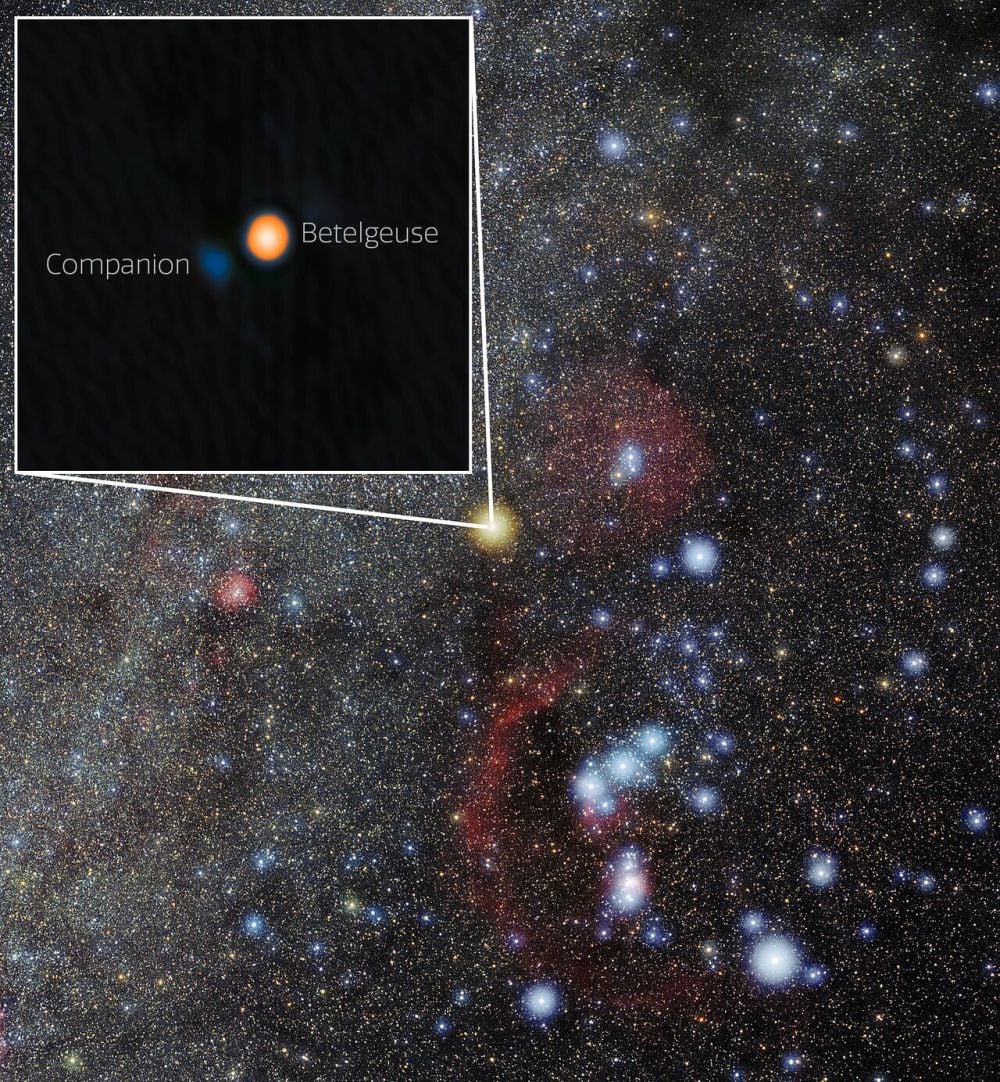
Using the NASA-NSF-funded ‘Alopeke instrument on the Gemini North telescope, astronomers have discovered a companion star in an incredibly tight orbit around Betelgeuse. This discovery answers the millennia-old question of why this famous star experiences a roughly six-year-long periodic change in its brightness. It also provides a clue into the physical mechanisms behind other variable red supergiants. The companion star appears blue here because, based on the team’s analysis, it is likely an A- or B-type star, both of which are blue-white due to their high temperatures. Image Credit: International Gemini Observatory/NOIRLab/NSF/AURA Image Processing: M. Zamani (NSF NOIRLab). Creative Commons Attribution 4.0 International License

Betelgeuse is a star that's never out of the news for long. It made headlines in recent years when it dimmed considerably, and since it's a red supergiant, people wondered if it was about to explode as a supernova. That expectation died down when scientists showed that the dimming is because of dust, but now Betelgeuse is in the news again, this time because of a newly-discovered companion star.

As one of the brightest stars in the sky, ancient astronomers kept an eye on Betelgeuse. They watched as its brightness varied, and even as its colour may have changed from yellow to red. As part of the well-known Orion constellation, countless human eyes have rested their gazes on it.

Astronomers using the Gemini North Telescope are some of the most recent humans to observe Betelgeuse. Gemini North is one half of the Gemini International Observatory. Gemini North is in Hawaii, and Gemini South is in Chile. Astronomers used Gemini North and its Alopeke instrument to detect a companion star around Betelgeuse for the first time.

The discovery is presented in research titled "Radial Velocity and Astrometric Evidence for a Close Companion to Betelgeuse." It's published in The Astrophysical Journal and the lead author is Morgan Macleod. Macleod is from the Harvard and Smithsonian Center for Astrophysics.

“This detection was at the very extremes of what can be accomplished with Gemini in terms of high-angular resolution imaging, and it worked." Steve Howell, NASA Ames Research Center.

Astronomers have long wondered about Betelgeuse and if it had an unseen, unresolvable companion. Researchers thought the star could be a spectroscopic binary. A spectroscopic binary is one where the pair of stars are so tight together that even our most powerful telescopes can't see them as separate objects. Instead, their presence is revealed by the Doppler effect on their light as the stars orbit.

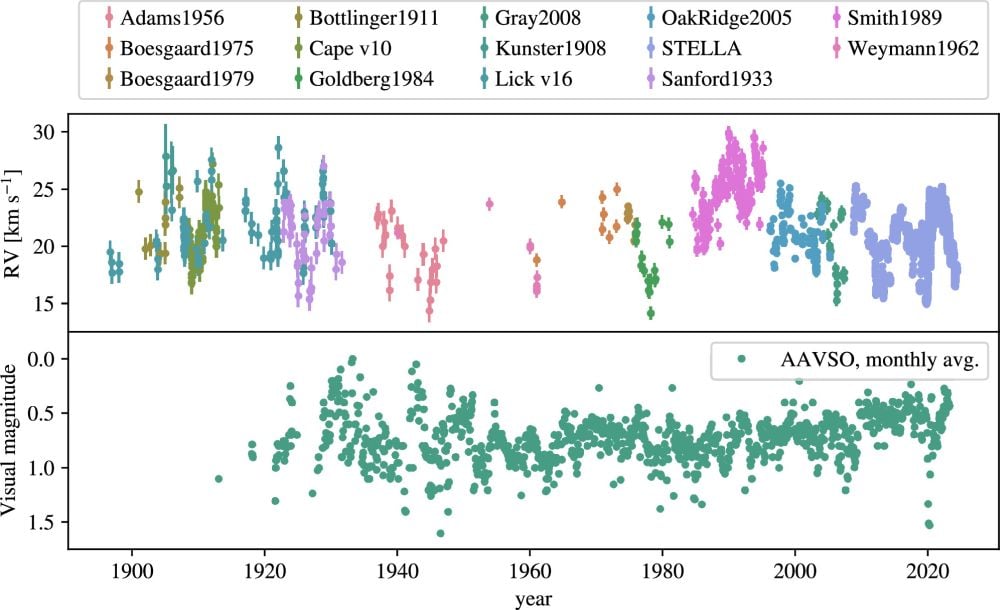
This new discovery is based on observational data acquired over the last century by different ground-based and space-based telescopes. Observations with Gemini North's Alpeke instrument capped it off. "We examine a century of radial velocity, visual magnitude, and astrometric observations of the nearest red supergiant, Betelgeuse, in order to reexamine the century-old assertion that Betelgeuse might be a spectroscopic binary," the authors write.

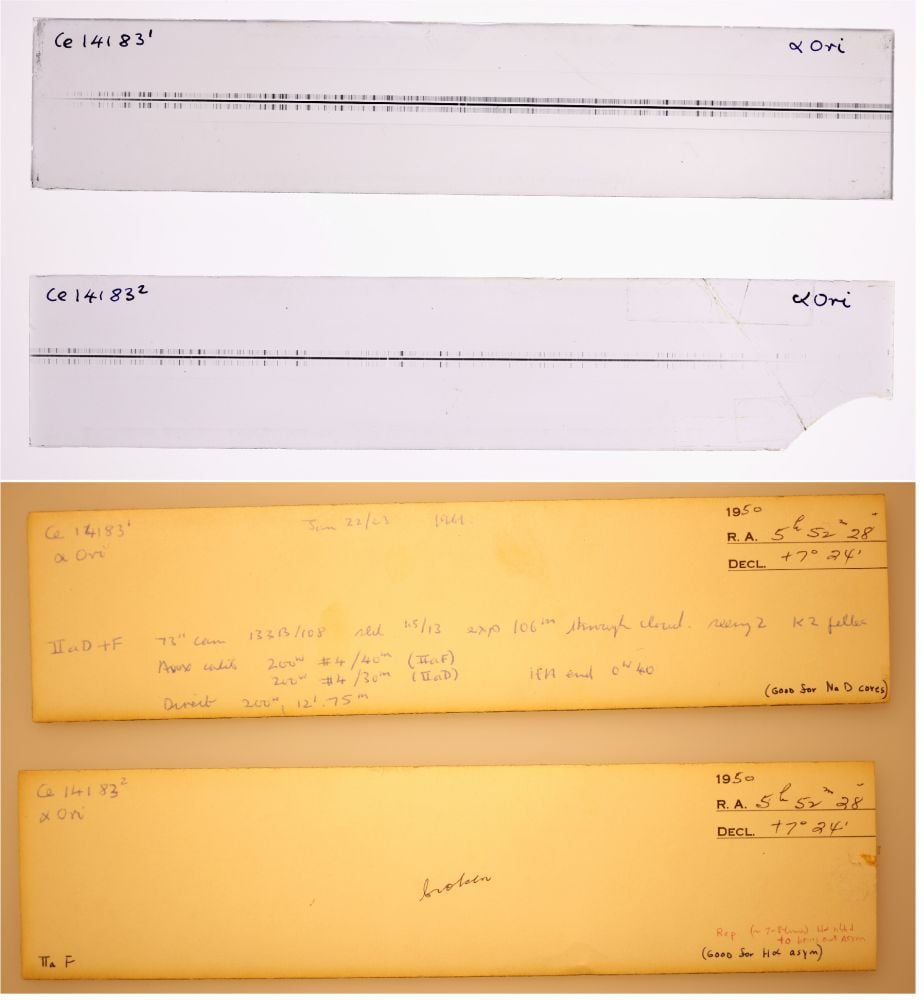
This is what astronomical data looked like before the computer age. They're red and blue spectral plates number 14183 from The Carnegie Science Plate Archive, taken with the Coude spectrograph on Mt. Wilson 1961 January 22 (R. Weymann 1962). Images are provided courtesy of Carnegie Science. This is what astronomical data looked like before the computer age. They're red and blue spectral plates number 14183 from The Carnegie Science Plate Archive, taken with the Coude spectrograph on Mt. Wilson 1961 January 22 (R. Weymann 1962). Images are provided courtesy of Carnegie Science.

Observations of Betelgeuse span a long enough time frame to detect two variable periods in its luminosity. One period is steady and lasts 5.78 years, and is called the long secondary period (LSP). The other consists of quasiperiodic pulsations that last several hundred days.

This figure from the research summarizes a century of Betelgeuse observations and reveals several trends. "Observed across the past century, Betelgeuse varies at a range of timescales from days to decades. Some of this variability appears periodic, while other portions appear uncorrelated," the authors write. The top panel shows radial velocity measurements that span 128 years. "The LSP is visible as a 5–6 yr sine-wave cycle of RV, most obvious in periods of denser sampling like 1900–1930 and 2000–present." Image Credit: Maclead et al. 2025. ApJ This figure from the research summarizes a century of Betelgeuse observations and reveals several trends. "Observed across the past century, Betelgeuse varies at a range of timescales from days to decades. Some of this variability appears periodic, while other portions appear uncorrelated," the authors write. The top panel shows radial velocity measurements that span 128 years. "The LSP is visible as a 5–6 yr sine-wave cycle of RV, most obvious in periods of denser sampling like 1900–1930 and 2000–present." Image Credit: Maclead et al. 2025. ApJ

"We show that the LSP is consistent between astrometric and radial velocity data sets, and argue that it indicates a low-mass companion to Betelgeuse, less than a solar mass, orbiting in a 2110 day period at a separation of just over twice Betelgeuse’s radius," the researchers explain. Betelgeuse has about 16.5 solar masses, and the companion star is about 20 times less massive than thats. It's also a million times fainter, and orbits Betelgeuse very tightly, separated by only four astronomical units. These numbers are preliminary because Betelgeuse's distance and mass are not precisely known.

Steve Howell, a senior research scientist at NASA Ames Research Center, led the team of astrophysicists that detected the companion with the Gemini North Telescope. In a press release, Howell said "Gemini North’s ability to obtain high angular resolutions and sharp contrasts allowed the companion of Betelgeuse to be directly detected. Papers that predicted Betelgeuse’s companion believed that no one would likely ever be able to image it."

But Gemini North and its Alopeke instrument were up to the task. Gemini North is an 8.1-metre (26.6 ft) optical/infrared telescope with several powerful instruments attached. Alopeke, which means 'Fox' in Hawaiian, is a speckle imager. It overcomes atmospheric distortion by taking multiple very short exposures that basically "freeze" the atmospheric distortion, allowing the telescope to work at high angular resolutions.

Betelgeuse and its companion in the context of the Orion Constellation. Image Credit: International Gemini Observatory/NOIRLab/NSF/AURA. Image Processing: M. Zamani (NSF NOIRLab) Betelgeuse and its companion in the context of the Orion Constellation. Image Credit: International Gemini Observatory/NOIRLab/NSF/AURA. Image Processing: M. Zamani (NSF NOIRLab)

Betelgeuse is well-known for its Great Dimming episode in 2019/20. Astronomers determined that it was likely caused by a sudden and anomalous ejection of mass, and this research suggests the companion could've played a role in that event. "However, if a burst of mass loss collided with a preexisting tail or shell trailing behind a companion object, shocking before cooling and forming dust, that could explain the sudden onset of the great dimming," the researchers explain.

That idea has broad implications for our understanding of Betelgeuse and other red supergiants. "If correct, this might suggest that mass ejection episodes like the one that caused the great dimming are happening continuously in a star like Betelgeuse—this one just happened to have fortuitous alignment with the companion orbit and us as observers," the authors write.

The researchers think that the companion likely hasn't begun hydrogen fusion and is a pre-main sequence star. That can explain its low-mass; it's still accreting material. That means that even though the pair likely formed from the same gas cloud, they're an odd couple. While Betelgeuse is evolving away from the main sequence, its tiny companion hasn't entered it yet.

There are multiple examples of other binary stars where the masses are lopsided. There are also multiple examples of other giant stars with long secondary periods, and other researchers have argued that these are caused by undetected companions. Antares could be one of them. "Indeed, Antares, another of the closest and brightest red supergiants, also hosts an LSP with photometric and RV variations that imply a companion," the authors write.

The companion star's fate is all tangled up with Betelgeuse's. Betelgeuse will explode as a cataclysmic supernova, destroying everything in its vicinity. However, the small, dim companion might succumb to its fate long before that happens. Within the next 10,000 years, according to the researchers, Betelgeuse's strong gravity will suck the companion in and it will meet its doom. Its starstuff will be expelled back into the interstellar medium when Betelgeuse explodes.

This discovery could open the door to observing more spectroscopic binaries. If it does, then astronomers may be on their way to explaining more LSPs in red supergiant stars. “This detection was at the very extremes of what can be accomplished with Gemini in terms of high-angular resolution imaging, and it worked. This now opens the door for other observational pursuits of a similar nature,” said Howell.

"While it is perhaps surprising that Betelgeuse could have such a close companion, we emphasize that a low-mass companion would essentially be hidden in plain sight—nearly a million times less luminous and of similar color to Betelgeuse itself," the researchers write in their conclusion. They also emphasize that their conclusion is not absolute. Some other unknown mechanism could be responsible.

"However, the predictions of the binary model are now clear and offer a pathway toward a deeper understanding of our nearest red supergiant," they conclude.

New Horizons Could Find Its Way to Proxima Centauri if it Wanted

by: Carolyn Collins Petersen (https://www.universetoday.com/authors/cc-petersen)

New Horizons Could Find Its Way to Proxima Centauri if it Wanted

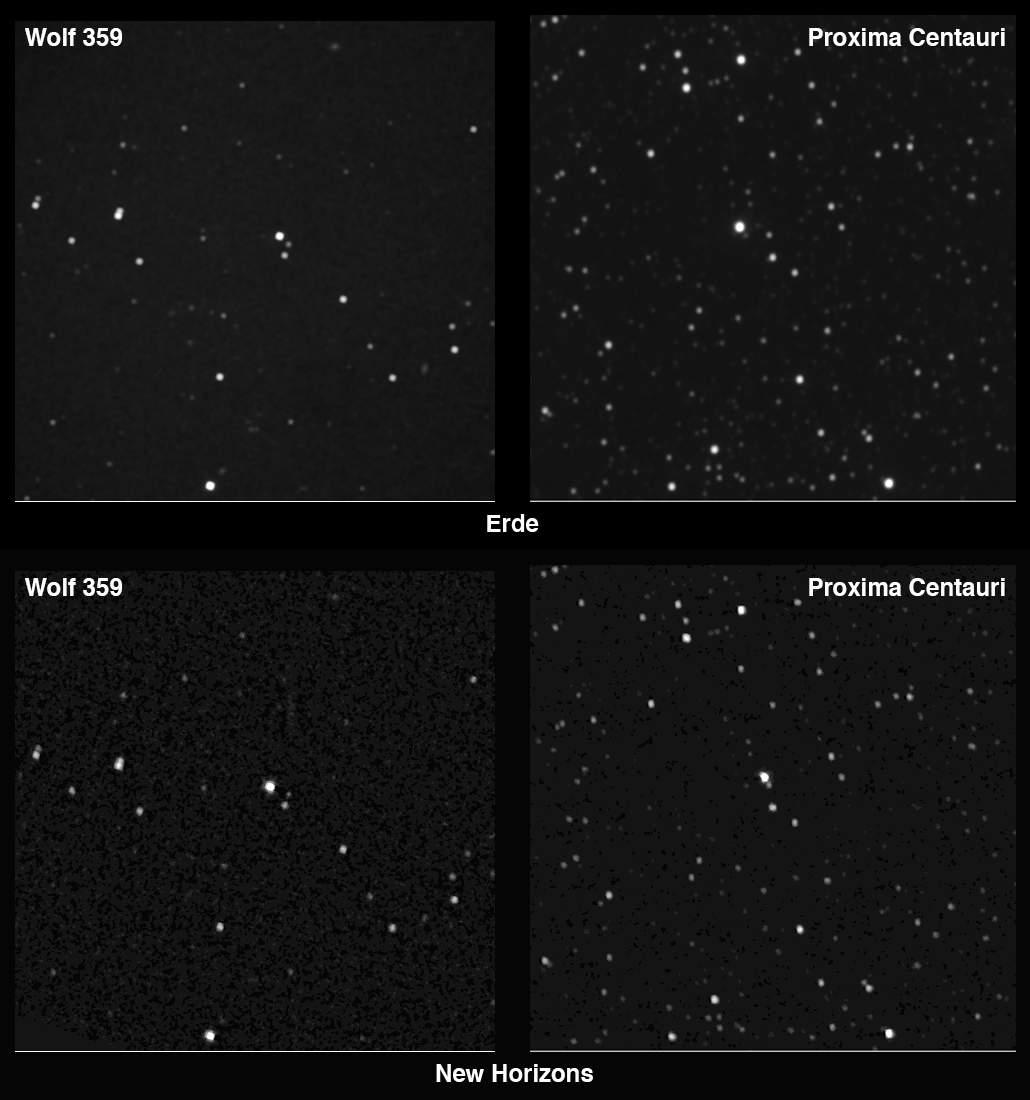
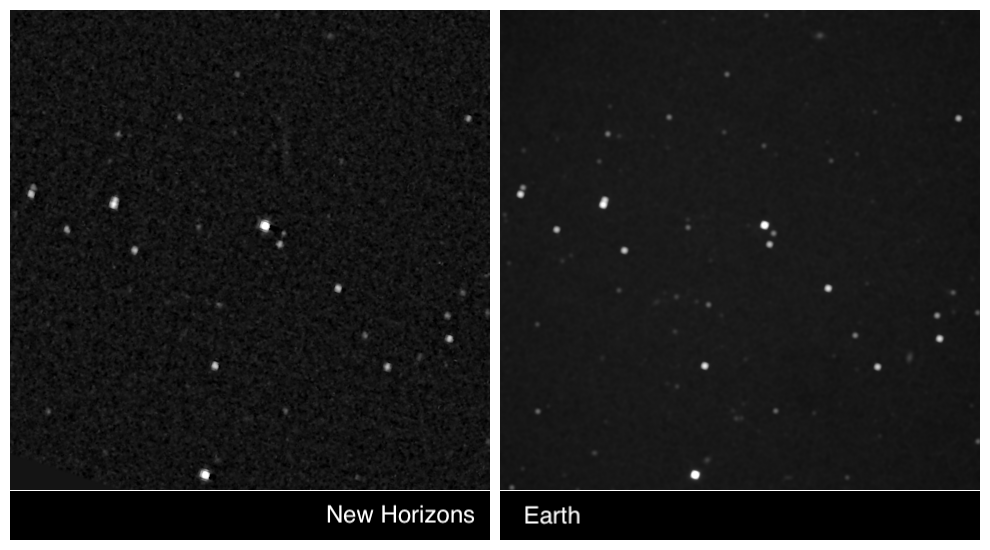
This set of two-frame animations blinks back and forth between New Horizons and Earth images of Wolf 359 and Proxima Centauri. They clearly illustrate the different view of the sky New Horizons has from its deep-space perch. Credit: NASA/Johns Hopkins Applied Physics Laboratory/Southwest Research Institute/University of Louisville/Harvard and Smithsonian Center for Astrophysics/Mt. Lemmon Observatory

The New Horizons spacecraft is humanity's fastest-moving spacecraft and headed to interstellar space. Since its exploration of Pluto 10 years ago and subsequent flyby of Arrokoth in 2019, it's been traversing and studying the Kuiper Belt while looking for other flyby objects. That's not all it's been doing, however. New Horizons also has an extended program of making heliophysics observations. The mission science team has also planned astrophysical studies with the spacecraft's instruments. Those include measuring the intensity of the cosmic optical background and taking images of stars such as Proxima Centauri. As the spacecraft moves, the apparent positions of its stellar navigation targets have changed, but that hasn't bothered New Horizons one bit. It knows exactly where it is thanks to 3D observations of those nearby stars.

A recent paper released by the team of scientists connected to the New Horizons mission (see references) presents the startling change in parallax view that the spacecraft provided. New Horizons has achieved a breakthrough: the first time optical stellar astrometry has been performed as a way to get the three-dimensional location of a spacecraft with respect to nearby stars. It's also the first time any method of interstellar navigation has been demonstrated for a spacecraft on a trajectory out of the Solar System. The paper's conclusions suggest that future spacecraft heading out into the wider galaxy would do well to use a single pair of nearby stars in an astrometric approach to navigation.

Navigation by the Stars

Using the stars for navigation isn't a new idea. People have done it on Earth throughout history, getting across the continents, sailing the seas, and more lately, traveling in the Solar System. Still, navigational methods rely on Earth-centered measurements along with star-sighting techniques. For example, the Voyager spacecraft, the Hubble Space Telescope, and others have star trackers to help keep them in the proper attitude and on course (in the case of Voyager and New Horizons). What happens when you (or your spacecraft) leave the Solar System? In science fiction books, movies, and TV shows, starships fly hither and yon, such as the spacecraft in the Star Trek universe. They use a combination of galactic databases, so-called "subspace sensors", and other advanced methods to warp their way through the Milky Way (and beyond). The methods might look familiar to us today, even if the technology doesn't.

The New Horizons mission teams used optical navigation techniques to guide the spacecraft to Pluto and Arrokoth. These include an onboard camera to take images of the targets (Pluto, Charon, etc.) against a backdrop of reference stars, as well as image processing techniques. Once it leaves the Solar System behind, the spacecraft will rely on interstellar navigation methods using the same optical navigation practices. The team's paper describes the challenges in doing that. They state, "Besides needing to know what direction we’re headed in, we will also need to know how far we’ve traveled. Our motion will appear to shift the positions of nearby stars with respect to more distant ones—and that will tell us how far we’ve gone. We can demonstrate this with images obtained by NASA’s New Horizons spacecraft on 2020 April 22-23, when it was then 47 AU distant from the Sun, passing through the Kuiper Belt."

In other words, the images and measurements of distant stars and their parallaxes will allow spacecraft operators to triangulate mission positions quite accurately. So, in the future, if time, money, fuel, and equipment were in infinite supply, New Horizons could be guided toward stellar targets. Conceivably, if it had the ability to make its own travel plans, it could take itself anywhere it (or its designers) wanted it to go, including to the nearest star in our neck of the Galaxy: Proxima Centauri.

It's About Parallax

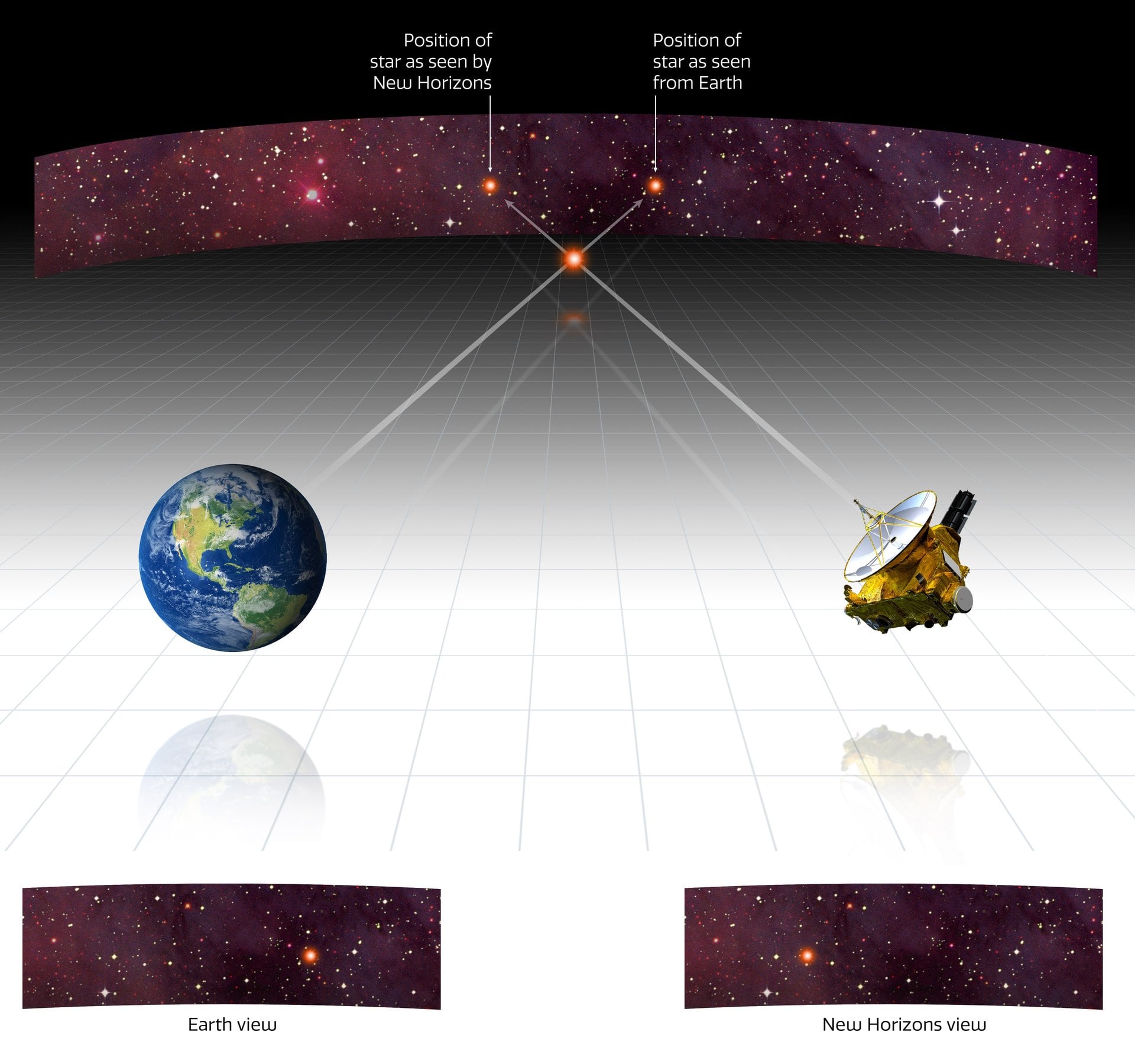
This figure illustrates the phenomenon of stellar parallax. When New Horizons and observers on Earth observe a nearby star at the same time, it appears to be in different places compared to more distant background stars—this is because New Horizons has traveled so far out in space that it has to look in a different direction to see that star. Credit: Pete Marenfeld, NSF’s National Optical-Infrared Astronomy Research Laboratory This figure illustrates the phenomenon of stellar parallax. When New Horizons and observers on Earth observe a nearby star at the same time, it appears to be in different places compared to more distant background stars—this is because New Horizons has traveled so far out in space that it has to look in a different direction to see that star. Credit: Pete Marenfeld, NSF’s National Optical-Infrared Astronomy Research Laboratory

Anyone who's taken an astronomy class learned about parallax measurements by holding a finger up and looking at something in the distance with one eye at a time. When you do that, the position of the finger changes as you blinked back and forth. Using Earth's motion throughout the year with respect to distant objects also can approximate parallax on a grander scale. Real parallax measurements require observing a star for a number of years to measure its apparent motion against the backdrop of more distant ones. The end result gives a parallax "view" that looks like a change in the star’s proper motion. Finally, even the nearest stars have tiny parallaxes. Interestingly, Pluto itself was found using this "positional shift" by Clyde Tombaugh in 1930. He took images of the sky where Pluto was thought to be and then viewed them through a "blink comparator" to detect its motion against the stars (and as Earth moved in its orbit).

Some 76 years after Tombaugh's discovery, the New Horizons mission set out for the Pluto system. The spacecraft depended on optical navigation and a Jupiter assist to get it out to the correct spot in the Kuiper Belt. Finding Pluto was a challenge, since its orbit was only tracked for about a third of its time and that induced some uncertainty in its exact location. New Horizons had a general sense of Pluto's position, and that location was tweaked by feedback from the optical navigation system as the spacecraft approached. As New Horizons's position changed throughout flight, the positions of its guide stars (and targets) appear to change, as well, in a fine demonstration of parallax shift.

Presently, New Horizons is just over 62 AU from Earth—that's its Earth-spacecraft (ES) baseline. On April 22-23, 2020, when the spacecraft was about 42 AU away, the New Horizons team used the LORRI (Long-range Reconnaissance Imager) camera to image the star fields containing the nearby stars Proxima Centauri and Wolf 359. At that time, it was the largest such baseline made to that date. These measurements, although not as accurate as those made by Gaia, for example, are still useful to show how parallax works using real objects in space.

For this view of the parallax of Wolf 359, cross your eyes until the pair of images merges into one. It might help to place your finger or a pen just a couple of inches from your eyes, and focus on it. When the background image comes into focus, remove the closer object and concentrate on the image. Credit: NASA/Johns Hopkins Applied Physics Laboratory/Southwest Research Institute/John Spencer/University of Louisville/Harvard and Smithsonian Center for Astrophysics/Mt. Lemmon Observatory For this view of the parallax of Wolf 359, cross your eyes until the pair of images merges into one. It might help to place your finger or a pen just a couple of inches from your eyes, and focus on it. When the background image comes into focus, remove the closer object and concentrate on the image. Credit: NASA/Johns Hopkins Applied Physics Laboratory/Southwest Research Institute/John Spencer/University of Louisville/Harvard and Smithsonian Center for Astrophysics/Mt. Lemmon Observatory

The shifts in position measured with simultaneous Earth and New Horizons observations are a significant fraction of an arcminute for the nearest stars. If you look at the Earth-based images of the spacecraft's target stars and compare them to the New Horizons images, it's fairly easy to see the displacement of the targets against the backdrop of more distant stars. This method is actually a pretty good analog to the astronomy class experiment of holding your finger up and looking at it while blinking your eyes.

What's Next?

The New Horizons parallax experiment was a big first step in learning the techniques of stellar navigation. If it's used to make these measurements again, the team suggests taking a larger number of images to get better measurements of stellar positions. That would make good use of the only asset currently exploring the Kuiper Belt, which is turning out to be way more interesting than expected. New Horizons is expected to exit the Kuiper Belt late in this decade and has enough fuel to power it through the 2030s. Whether or not the mission gets cut off by NASA after it leaves the Kuiper Belt is an open question at this time.

Future spacecraft to visit the outer Solar System and beyond will be designed with autonomous (self-guiding) navigation technology, particularly coupled with improvements in imaging and image processing, along with applications of artificial intelligence. In addition, while using stars is a good baseline, radio and X-ray pulsar measurements could improve navigation. These rely on a known database of such objects and have also been suggested for navigation purposes here on Earth. In space, those measurements will supply much more accurate data, not just about the pulsars, but about the exact position in space of the craft taking them.

For More Information

A Demonstration of Interstellar Navigation Using New Horizons

Optical Navigation Preparations for New Horizons Pluto Flyby

Star Trek Navigation

Are the JWST's Little Red Dots Actually Supermassive Black Hole Seeds?

by: Evan Gough (https://www.universetoday.com/authors/ion23drive)

Are the JWST's Little Red Dots Actually Supermassive Black Hole Seeds?

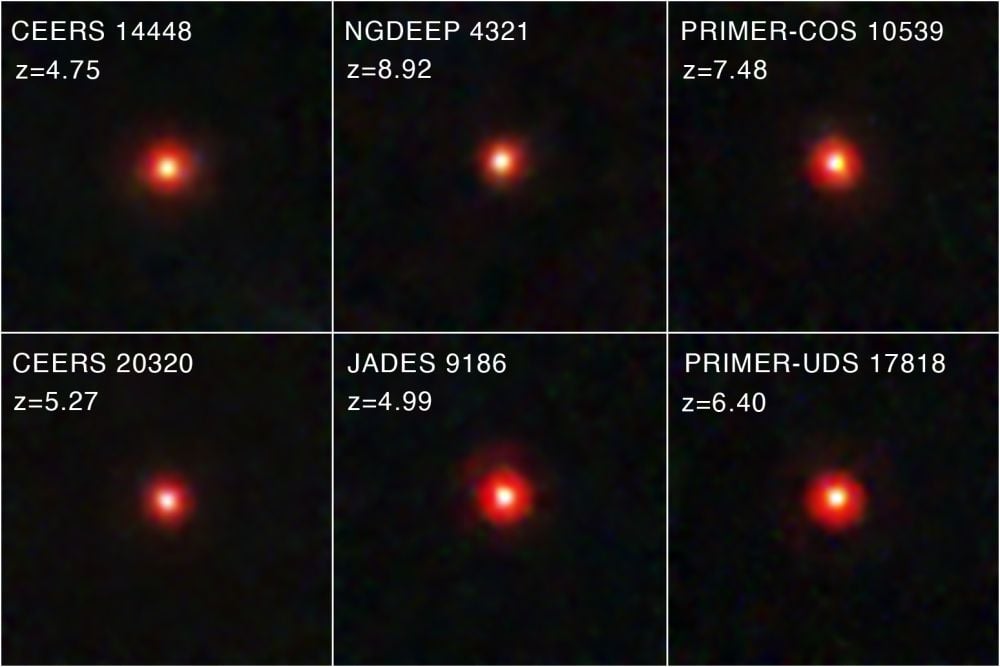
When the JWST detected Little Red Dots only 600 million years after the Big Bang, it was a puzzling find. Early thinking suggested that they're galaxies, but not everyone agrees. Image Credit: NASA, ESA, CSA, STScI, Dale Kocevski (Colby College)

When the JWST began science observations in July 2022, it flung open a whole new window on the Universe. The JWST looked further back in time than any other telescope, and it revealed several surprises. One of them was the Little Red Dots (LRD), ancient, faint objects that the powerful space telescope detected as far back as only 600 million years after the Big Bang.

The JWST found more than 300 LRDs, and their brightness suggested enormous stellar masses. While early thinking suggested they're galaxies, not all agreed, and there were still many questions. There were so many LRDs at such an early time that their existence clashed with our understanding of the early cosmos. What all scientists do seem to agree on is that these objects are quintessential to understanding the growth and evolution of the Universe into what we see today.

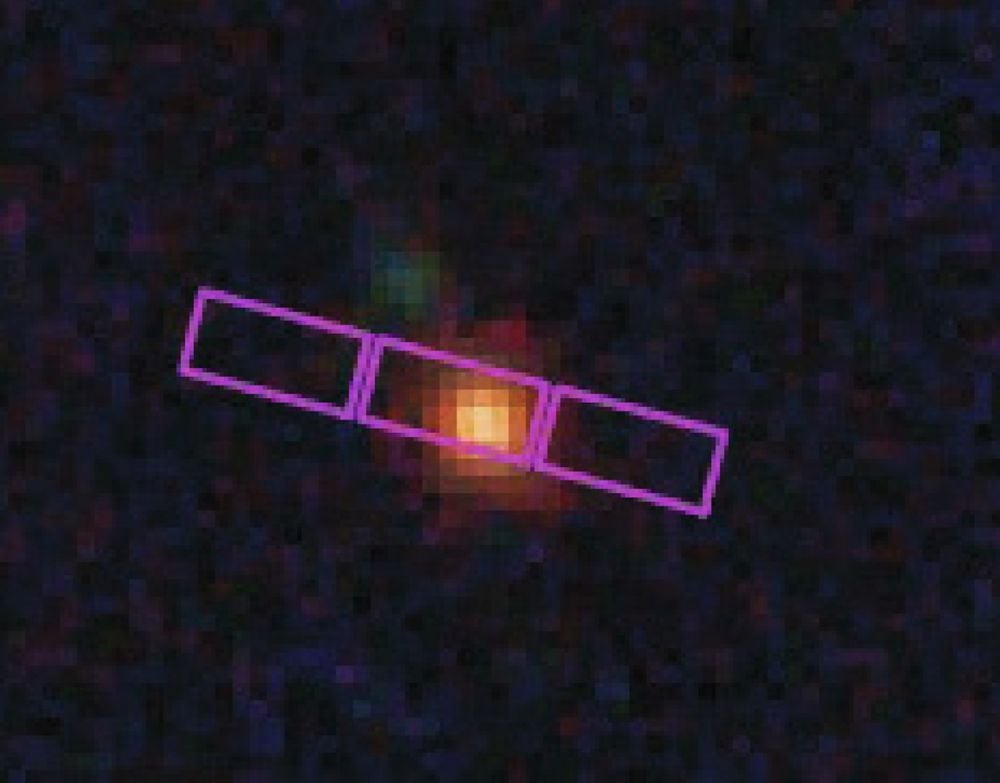
LRDs are faint and challenging to observe, as this RGB image created from the JWST image filter data shows. Image Credit: Killi et al. 2024. A&A LRDs are faint and challenging to observe, as this RGB image created from the JWST image filter data shows. Image Credit: Killi et al. 2024. A&A

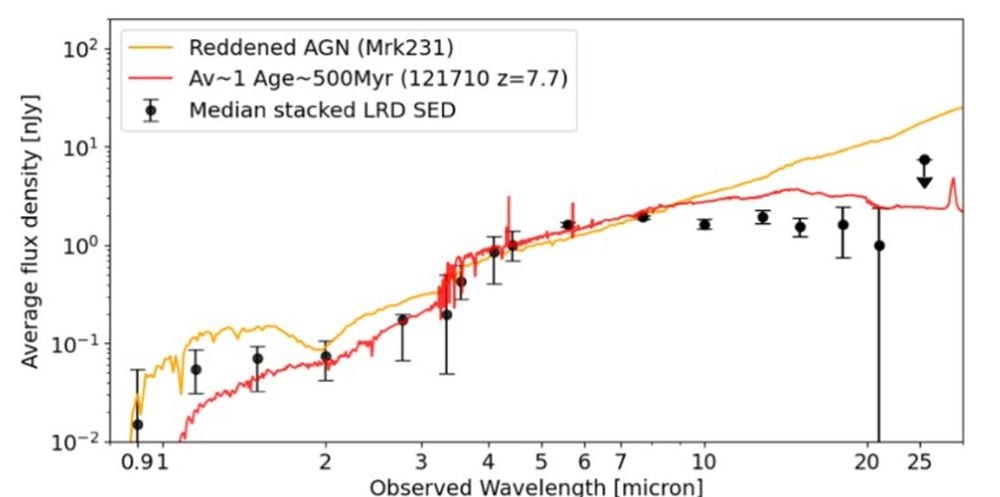
Initial study showed that the LRDs are active galactic nuclei (AGN) with supermassive black holes (SMBH) in their centers. This can explain their distinct red colour, likely caused by enormous amounts of gas and dust surrounding the objects as accretion disks. But in other respects, they don't resemble AGN. They emit no detectable x-rays, have a flat spectrum in the infrared, and show very little variability.

This figure from previous research shows the infrared spectra from LRD's (red) with the spectrum from a well-studied AGN named Mrk231. While the AGN spectrum is expected to show a steeply rising shape at longer wavelengths, the LRD's is flat. Image Credit: Williams et al. 2024. ApJ This figure from previous research shows the infrared spectra from LRD's (red) with the spectrum from a well-studied AGN named Mrk231. While the AGN spectrum is expected to show a steeply rising shape at longer wavelengths, the LRD's is flat. Image Credit: Williams et al. 2024. ApJ

New research suggests that the LRDs are not actually galaxies, but instead a type of hypothesized star called Supermassive Stars (SMS). Astronomers think that SMS are critical intermediate stages in the formation of SMBH seeds. These SMBHs power the quasars that scientists have observed in the early Universe.

The research is "Supermassive Stars Match the Spectral Signatures of JWST's Little Red Dots." The authors are Devesh Nandal from the Department of Astronomy at the University of Virginia, and Abraham Loeb from the Harvard and Smithsonian Center for Astrophysics. The research is available at arxiv.org.

"The James Webb Space Telescope (JWST) has unveiled a population of enigmatic, compact sources at high redshift known as “Little Red Dots” (LRDs), whose physical nature remains a subject of intense debate," the authors write. "Concurrently, the rapid assembly of the first supermassive black holes (SMBHs) requires the formation of heavy seeds, for which supermassive stars (SMSs) are leading theoretical progenitors."

The researchers set out to quantitatively test the hypothesis that the LRDs are in fact primordial SMS.

SMS are thought to have around 10^6 solar masses. The idea is that these stars could only form in the early Universe, and that they exploded as core-collapse supernova that created early black holes that became seeds for SMBH. They can explain why researchers find SMBHs so early in cosmic time, long before they should exist according to current theories.

"LRDs may represent the direct photospheric light of accreting SMS caught in the final ≲ 10^3 yr before collapse," the authors write. "This short lifetime is consistent with the rarity of LRDs, suggesting they are a fleeting but crucial phase in galaxy and black hole formation."

The researchers developed detailed atmospheric models for an SMS with 10^6 solar masses and no metals. Since these stars are Population 3 stars, there should be contain no metals. Their model was able to account for the observed characteristics of LRDs.

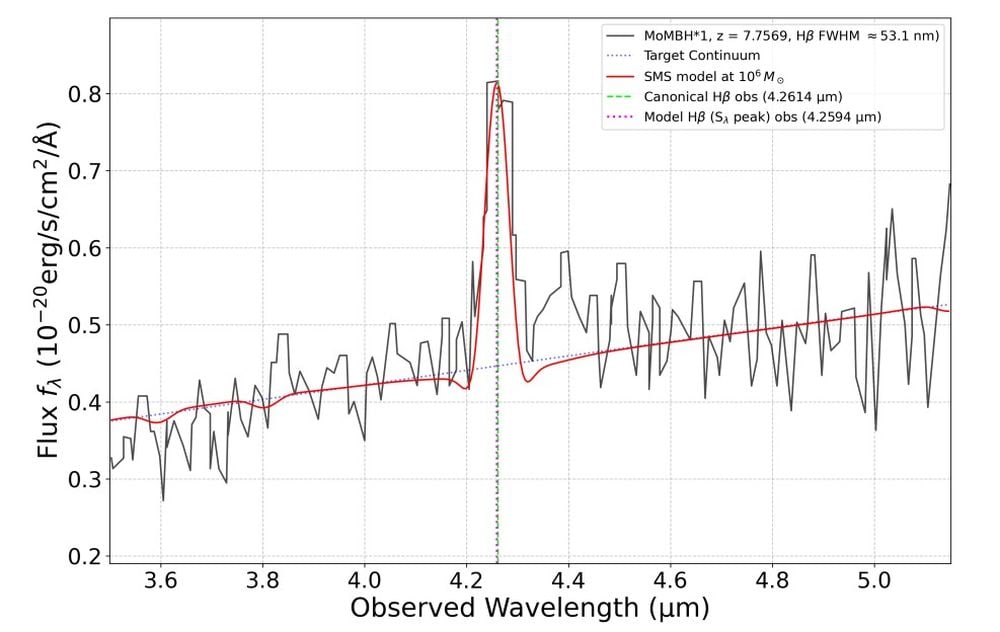
The simulated SMS matched the luminosity of LRDs, and the spectral features also matched. This is critical, because, as the authors explain, "The ultimate test of our model is its ability to reproduce the observed spectra of LRDs." For their work, they focused on two LRDs called MoM-BH*-1 and The Cliff, objects that feature prominently in scientific literature.

"A defining characteristic of the LRD spectra is the simultaneous presence of a strong, broad Hβ emission line alongside other Balmer lines in absorption," the authors explain. They say that these are caused by the extended dense photosphere around SMSs.

This figure from the research shows the spectrum for MoM-BH*-1, one of the JWST's Little Red Dots (black), and the spectra from the simulated supermassive star (red). A vertical green dashed line and red dotted line overlap, indicating agreement for the prominent H beta emission from the LRD. Image Credit: Nandal and Loeb 2025. This figure from the research shows the spectrum for MoM-BH-1, one of the JWST's Little Red Dots (black), and the spectra from the simulated supermassive star (red). A vertical green dashed line and red dotted line overlap, indicating agreement for the prominent H beta emission from the LRD. Image Credit: Nandal and Loeb 2025.*

Nandal and Loeb say that their work is "a first-principles investigation into whether Population III supermassive stars (SMSs) can serve as the central engines for the enigmatic class of objects known as Little Red Dots (LRDs)."

They've shown that SMS with 10^6 solar masses match the luminosity of LRDs. They've shown that an extended stellar photosphere around the SMS can account for the V-shaped Balmer break seen in LRDs. They've also shown that SMS spectra match the observed spectra of LRDs.

"In conclusion, our SMS model provides a remarkably simple and self-consistent physical picture for LRDs," the authors write. While other models showing that LRDs are active galactic nuclei require separate components for emission, absorption, and continuum, theirs presents a unified origin. This is in line with Occam's Razor, which urges us to search for explanations with the smallest number of elements.

While one study doesn't prove anything outright, this one lays the groundwork for deeper research. "Future work should aim to build upon the foundation laid here," the researchers write in their conclusion. Expanded models could explore whether or not their are different pathways for SMS with different masses and other properties to form the observed LRD population.

The Little Red Dots are extremely difficult to observe and are at the edge of the JWST's capabilities. While there may be a more powerful successor to the JWST one day, for now, scientists have to work with what they've got.

If it is proven that the Little Red Dot galaxies aren't galaxies at all, but are instead supermassive stars that are the progenitors of today's supermassive black holes (SMBH), we will have an answer to one of the most compelling questions in astronomy. Scientists can continue to make the case that LRDs are actually SMS, but they may not be able to confirm until well into the future.

How To Detect Magnetic Fields Around Exoplanets

by: Andy Tomaswick (https://www.universetoday.com/authors/andy-tomaswick)

How To Detect Magnetic Fields Around Exoplanets

Artist's impression of a "hot jupiter" transiting its star. Credit - ESO/M. Kornmesser

Magnetic fields play an important, if sometimes underappreciated, part in planetary systems. Without a strong magnetic field, planets can end up as a barren wasteland like Mars, or they could indirectly affect massive storms as can be seen on Jupiter. However, our understanding of planetary magnetic fields are limited to the eight planets in our solar system, as we haven’t yet accrued much data on the magnetic fields of exoplanets. That could be about to change, according to a new preprint paper by a group of research scientists from Europe, the US, India and the UAE.

According to the paper, there are two main ways scientists could collect data on exoplanet magnetic fields. First is a direct detection using two “effects” known as the Hanle and Zeeman effects. The other is indirect which utilizes “hot spots” in a host star’s atmosphere.

For direct detection, an observatory would need to capture photons that travel through the planet’s atmosphere as it is making a transit. Given that transits are one of the primary ways exoplanets themselves are detected, there should be plenty of data of these events. With those photons in hand, the researchers could analyze them for the Hanle and Zeeman effects.

Fraser discusses detecting magnetic fields around an Earth-like exoplanet.

The Hanle effect happens when light that is affected by a magnetic field, especially one that is perpendicular to the line of sight. These polarized light beams can be absorbed by helium atoms in the planet’s atmosphere, making a clear spectrographic line at the “He I 1083 triplet”. Importantly, this effect is even in place for relatively weak magnetic fields, so it could be utilized for probing magnetic fields that are even weaker than Earth, though the orientation of the field plays an important role in what strength it is able to measure.

Polarization also plays a role in the Zeeman effect, but instead of linear polarization in a certain orientation, the Zeeman effect looks at circular polarization instead of the linear polarization used in the Hanle effect. Light passing through an exoplanet magnetic field could be circularly polarized by magnetic field lines pointing along the line of sight of the observatory, which meshes nicely with the perpendicular magnetic field lines that cause the Hanle effect.

Combining the two of these effects can provide a relatively clear picture of the strength and orientation of an exoplanet’s magnetic field. An additional advantage is that, since they use a differential measurement, its easy to remove potentially confounding data like photons from the host star itself. However, since those photons must pass through the exoplanet’s atmosphere, there also aren’t very many of them, so this technique only works with larger planets that are close to their host star.

Fraser discusses possibilities for the future of exoplanet research.

Indirect methods also require the host planets to be close to their star, but for a different reason. They identify stellar hot spots that are the manifestation of magnetic field interactions between the star and the planet. The planet, whose size doesn’t matter as much in this scenario, must be close enough to its host star to be within its Alfvén surface, a space defined by the area where star/planet magnetic interactions are supposed to occur.

Even Mercury isn’t within our Sun’s Alfvén surface, which is typically between 10 and 20 solar radii from the surface of the star. However, since the majority of exoplanets that have been found orbit very close to their parent star, that isn’t necessarily a disadvantage. This technique does have other disadvantages, though, like trying to disentangle whether the magnetic activity causing the hotspot is from a planet or from some other dynamic system in the star’s magnetic field itself.

Ultimately more science, and therefore more data, is needed. The authors hope future missions like the Habitable Worlds Observatory (HWO) will be well placed to collect the type of data needed to analyze these potential magnetic fields. That’s not to say current observatories can’t do some preliminary work with strong magnetic fields, but given that HWO won’t be launching for at least another 15 years, it might be a while before we truly get a better understanding of the magnetic fields of planets outside our own system.

Learn More:

A. Strugarek et al - Detecting and characterising the magnetic field of exoplanets

UT - Detecting Exoplanets by their Magnetospheres

UT - Measuring Exoplanetary Magnetospheres with the Square Kilometer Array

UT - Magnetic Fields Help Shape the Formation of New Planets

Scientists are Planning for Life After Finding Aliens

by: Mark Thompson (https://www.universetoday.com/authors/mark)

Scientists are Planning for Life After Finding Aliens

With advanced observatories coming online like the Vera Rubin Telescope, scientists are looking to plan for the discovery of alien intelligence and how humanity should prepare for the news.

Just imagine it, the news stories are all over your phone when you wake! The day will surely come that we will discover that we are not alone in the Universe! What happens the day after though? A new research paper from the SETI Post Detection Hub at the University of St Andrews tackles this question, outlining how NASA and the global scientific community should prepare for the moment humanity detects signs of extraterrestrial intelligence.

The paper, written by 14 researchers representing institutions from York University to the University of Cambridge, emphasises that "a technosignature detection will trigger a complex global process shaped by uncertainty, misinformation, and multiple ideological stakeholders." Unlike searching for simple microbial life, discovering technological signatures from alien civilizations would fundamentally reshape our understanding of our place in the universe and create unprecedented challenges.

The Arecibo Radio Telescope was one of the first to be used for the search for alien intelligence. (Credit : H. Schweiker/WIYN and NOAO/AURA/NSF) The Arecibo Radio Telescope was one of the first to be used for the search for alien intelligence. (Credit : H. Schweiker/WIYN and NOAO/AURA/NSF)

The researchers led by Kate Genevieve from the Astro Ecologies Institution argue that past preparation efforts, including guidelines from 1989, are woefully outdated for our internet age. Early protocols predate the internet and could not account for the complexity of rapid global media dissemination. In an era of viral misinformation and instant global communication, the discovery of alien technology would likely create a media firestorm unlike anything humanity has experienced.

The team proposes six critical areas where NASA should invest now, before any discovery occurs. These range from advancing detection technologies to studying how different cultures might interpret the news of extraterrestrial discovery.

One fascinating aspect of the research involves developing "Other Minds" paradigms, essentially preparing to recognise intelligence that doesn't think like us. The paper suggests that techniques from bioacoustics, machine learning and quantum computing offer significant insights, including studying whale songs and bird navigation to understand non human communication patterns.

Researchers suggest that studying whale song can help understand non-human forms of communication such as those that may be experienced from alien intelligence! Researchers suggest that studying whale song can help understand non-human forms of communication such as those that may be experienced from alien intelligence!

This approach challenges researchers to move beyond Earth centric assumptions. If aliens communicate through methods we've never imagined, perhaps using quantum entanglement or patterns we haven't recognised, then our current detection methods might miss them entirely.

Surprisingly, much of the preparation work focuses not on alien technology but on human psychology and interaction. The researchers emphasise integrating humanities and social sciences, recognising that the biggest challenges might come from how people react to the news rather than from the aliens themselves.

The paper recommends funding research on the psychological, social, and global dynamics of post detection scenarios and even suggests analyzing science fiction stories to understand how different cultures envision first contact. These fictional scenarios, the researchers argue, provide valuable insights into human expectations and fears.

Perhaps most practically, the team calls for creating robust international coordination systems before they're needed. They warn that without a Post Detection SETI Hub, NASA risks a gap in the system, akin to a Moon landing without astronaut retrieval. Just as NASA developed detailed protocols for Apollo missions, including quarantine procedures, the space agency needs comprehensive plans for managing a SETI discovery.

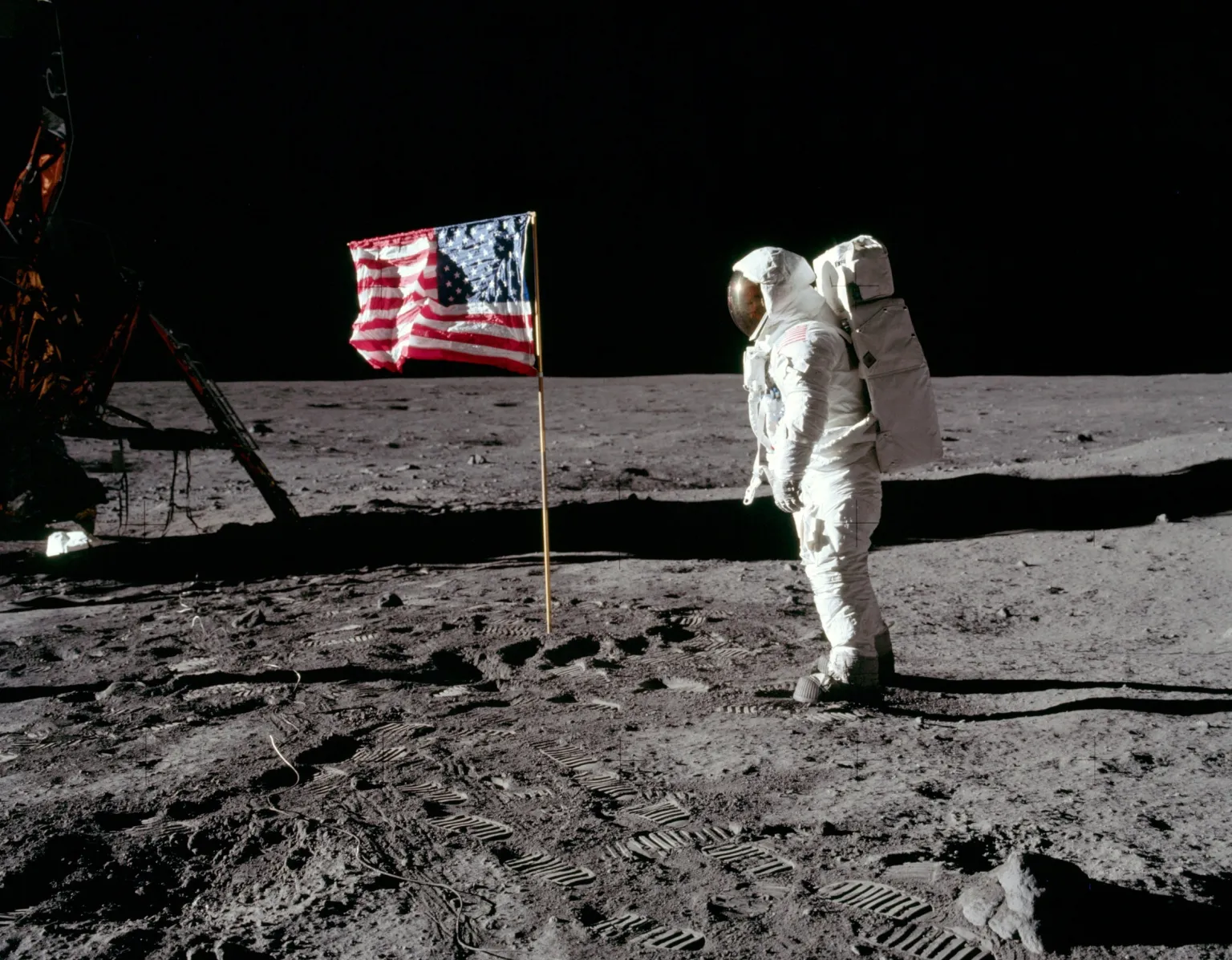
NASA implemented significant safety protocols during the Apollo era. Buzz Aldrin shown on the surface of the Moon captured by Neil Armstrong. (Credit : NASA) NASA implemented significant safety protocols during the Apollo era. Buzz Aldrin shown on the surface of the Moon captured by Neil Armstrong. (Credit : NASA)

The researchers don't claim that discovering extraterrestrial intelligence is imminent however, but they argue that preparation now is essential. With advanced telescopes like the James Webb Space Telescope already operational and instruments like the Vera C. Rubin Observatory coming online, a technosignature discovery could emerge in any realm of astronomy research.

Their message is clear: the question isn't whether we'll ever detect signs of alien technology, but whether we'll be ready when we do. By investing in research, international cooperation, and communication strategies now, NASA can help ensure that humanity's greatest discovery becomes a moment of unity and wonder rather than chaos and confusion.

Source : SETI Post-Detection Futures: Directions for Technosignature Research and Readiness